

What does “abortion abolitionist” mean? Results from SPL’s survey
Research like this helps us communicate more effectively. If you want SPL to keep doing this kind of careful, evidence-based work, consider becoming a monthly donor.
Introduction
In August 2026, Secular Pro-Life launched our “Who Counts as Anti-Abortion?” survey. We got over 500 responses.
We wanted to learn how people who oppose abortion think about our own movement, and how those views differ among SPL supporters, pro-life leaders and activists, and general social media followers of anti-abortion platforms.
The survey asks about the labels people choose for themselves (“pro-life,” “abolitionist,” “anti-abortion,” “consistent life/whole life,” or “other”) and what they think those labels mean. It also asks about the morality and legality of abortion, exceptions, penalties, how people came to oppose abortion, and their state’s abortion laws since Dobbs. A final set of short scenarios asks respondents to judge who counts as “anti-abortion” and who counts as an “anti-abortion activist.”
In this post, I’ll focus on the results related to questions about abortion abolitionism and the issue of legal penalties for women who abort. We asked respondents on 7-point scales to rate their positions regarding legal penalties for (1) women who abort and (2) abortion providers. We also asked an open-ended question about how people understand the term “abortion abolitionist.”
I’ve written previously about my significant disagreements with anti-abortion folks who think we should pursue laws that would charge women who abort with homicide. (See 6 reasons equal protection laws can’t be enforced justly.)
But this post is not about arguing for or against particular legislative approaches or movement strategies. This post is about correctly understanding people with different perspectives.
SPL prioritizes effective communication (see our comms trainings), which means understanding what people mean by the labels they use, and understanding views we disagree with well enough to describe them accurately. SPL also values coalition work (see our mission), which means finding common ground and working together where we can, even when we don’t agree on everything. This survey helps us do both.
Method
Data limitations
This was not a random sample. First we sent the survey to some of SPL’s core supporters (top donors and volunteers), and sought their feedback to improve clarity and objectivity before posting the survey more publicly.
Second, we sent the survey to leaders of pro-life organizations and major pro-life activists.
In this phase we sent the survey to leaders of organizations that identify as pro-life or anti-abortion, but do not identify as abolitionist. I specifically wanted to measure whether the “pro-life establishment” or “pro-life leaders” reflect the positions of the broader pro-life movement. Some of those pro-life leaders went on to share the survey with their staff or their social media followers, but only the responses from the leaders themselves were included in the “pro-life leaders and activists” group. The rest were included in the “general respondents” group.
The “activists” in the “pro-life leaders and activists” group were individual pro-lifers who have shown substantial leadership within the pro-life movement without formal affiliation with an organization. For example, individuals who have published peer-reviewed academic work, or those who have garnered national news coverage for their activism, would be included in the group.
Third, we sent the survey to SPL’s broader support base through our general mailing list, and we posted it publicly to all SPL social media channels.
The results reflect the people who saw the survey through those channels and chose to answer it. We can’t assume they represent the pro-life movement as a whole, much less all Americans who oppose abortion or the American public generally.
The groups also differ a lot in size. More than 300 people chose the label “pro-life” compared to only 40 who chose the label “abolitionist,” so small shifts in the latter group can move its percentages quite a bit.
Self-chosen labels
We asked, “Which of these terms best describes your opposition to abortion?” Respondents chose “pro-life,” “consistent life/whole life,” “anti-abortion,” “abolitionist,” or “other.” Throughout this post, labels like “abolitionist” or “consistent life” refer to the label a respondent chose for themselves.
Groups
In parts of this post we compare results by self-chosen label, and in other parts we compare the following three groups:
- Self-described abolitionists: Respondents who chose that label.
- General respondents
- Pro-life leaders and activists: people who work professionally in leadership roles for organizations focused on opposing abortion, or private individuals who have shown substantial leadership through their activism
Penalties for women who abort and for abortion providers
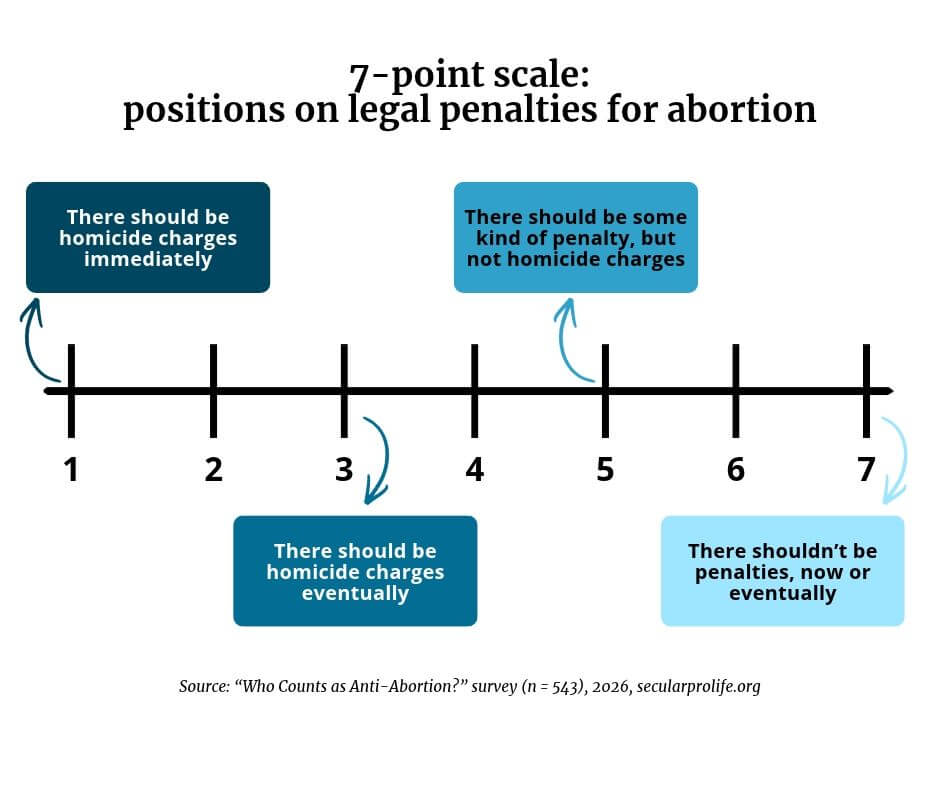
We asked respondents to rate their current position on legal penalties (both for women who abort and for abortion providers) using this 7-point scale:

For 5, examples of penalties for women who abort were community service, mandatory therapy, and fines; examples for abortion providers were loss of medical license, required additional training, and fines.
We left 2, 4, and 6 unlabeled so people could place themselves between the anchors.
For the charts below, we combined answers into three groups:
- 1 to 3: Homicide charges, now or eventually
- 4: Something in between
- 5 to 7: No homicide charges, now or eventually
The 5 to 7 band includes both people who want some lesser penalty and people who want no penalty at all.
Changes since Dobbs
After each penalty scale, we asked whether the respondent’s view had shifted since Dobbs: toward penalties, away from penalties, or not at all.
Open-ended definitions
We asked three open-ended questions about what people mean when they call themselves “pro-life,” an “abortion abolitionist,” or an “anti-abortion activist.” We sorted the answers into themes by keyword. Some answers fit more than one theme, so the percentages do not add to 100%.
When we call a difference “statistically significant,” we mean it passed a standard statistical test (Welch’s t-test) comparing that group to all other respondents. We rounded percentages to whole numbers, so some columns don’t add up to exactly 100%.
Results
Penalties for women who abort: varied responses
Three numbers describe each group below:
- mean – the average answer
- n – the number of people in the category, and
- standard deviation – how spread out the answers are (a smaller standard deviation means more agreement within the group)

Self-described abolitionists averaged 2.20. Most of them (60%) chose 1, meaning they support immediate homicide charges. But they didn’t all agree: 15% chose 5 to 7.
General respondents averaged 4.43, with the widest spread of the three groups. About half (50%) chose 5 to 7, and 35% chose 1 to 3.
Pro-life leaders and activists are those who work professionally in leadership roles focused on opposing abortion. This group averaged 5.16, near the “some penalty, but not homicide charges” anchor. They also agreed with each other somewhat more than the full group did. Most of them (63%) chose 5 to 7, while 20% chose 1 to 3 (only 4% chose 1).
The gaps are statistically significant. Leaders and activists differed from all other respondents, as did abolitionists.
How have views changed since Dobbs?
We also asked whether people’s views on penalties for women have shifted since Dobbs. A quarter of respondents (25%) said yes: 18% said they’ve shifted toward penalties, and 7% said they’ve shifted away.
Abolitionists were more likely to have changed their views since Dobbs, and especially more likely to have shifted toward penalties for women who abort. Among abolitionists, 35% said they’ve shifted toward penalties, and none said they’ve shifted away. Compare this to pro-life leaders and activists, where 6% said they’ve shifted toward penalties and 10% said they’ve shifted away.
How do self-chosen labels relate to policy positions?
Of those who support immediate homicide charges for women who abort, most don’t self-describe as “abolitionist.”
Of the respondents who chose 1 on the scale, only 40% chose the label “abolitionist.” Another 40% chose “pro-life,” 13% chose “anti-abortion,” 3% chose “consistent life,” and 3% chose “other.”
Of those who self-describe as “abolitionist,” most support homicide charges for women who abort (immediately or eventually).

Note: The abolitionist column totals 101% due to rounding. Another 21 respondents chose “other” (43% / 33% / 24%).
Moving from left to right (from “abolitionist” to “anti-abortion” to “pro-life” to “consistent life”), support for homicide charges drops and opposition rises.
- Abolitionist respondents lean toward immediate charges. Most abolitionists (60%) chose 1, and only 5% chose 7.
- Anti-abortion respondents lean toward eventual charges. Most of them (58%) supported homicide charges, but more chose 3 (“eventually”) than any other number. Only 12% chose 1.
- Pro-life respondents split. About half (53%) opposed homicide charges, but nearly a third (31%) supported them. This label had the most respondents by far, about 57% of the total.
- Consistent life respondents most often reject penalties. Almost three in four (73%) chose 5 to 7, and 42% chose 7, meaning no penalties at all. Only 2% chose 1.
Every label included at least some people all across the range of the 7-point scale for women who abort.
Penalties for abortion providers: more consistent responses
We asked a parallel question with a 7-point scale about penalties for abortion providers.

Self-described abolitionists averaged 1.10, with very little spread. Nearly all of them (95%) chose 1. (Compare this to their average of 2.20 for women who abort.)
General respondents averaged 2.15. Most (83%) chose 1 to 3, and about half (51%) chose 1, meaning they support immediate homicide charges for providers. Only 12% chose 5 to 7. (Compare this to their average of 4.43 for women who abort.)
Pro-life leaders and activists averaged 2.31, close to the “homicide charges eventually” anchor. Most of them (80%) chose 1 to 3, and 43% chose 1. (Compare this to their average of 5.16 regarding penalties for women who abort.)
Abolitionists still differed from all other respondents by a statistically significant margin, but leaders and activists did not.
Most respondents (80%) treated women and providers differently (79% gave a harsher answer for providers, 1% gave a more lenient one).
Another 19% of total respondents gave the same answer for both, including 60% of abolitionists.
How have views changed since Dobbs?
Fewer people said their views on provider penalties have shifted since Dobbs (16%, compared to 25% for women). Most of those shifted toward penalties (14%). Among leaders and activists, 6% said they’ve shifted toward penalties and 4% away. Among abolitionists, 15% said they’ve shifted toward penalties, and none said they’ve shifted away.

Note: The abolitionist column totals 101% due to rounding. Another 21 respondents chose “other” (76% / 5% / 19%).
For all labels, a clear majority supported homicide charges for providers, now or eventually. Even among consistent life respondents, the group most opposed to penalties for women, 71% chose between 1 and 3 for providers.
What does “abortion abolitionist” mean?
We asked respondents the open-ended question “When someone describes themselves as an ‘abortion abolitionist,’ what do you think they mean?”
Below are the major themes. (Again, some answers fit more than one theme, so the percentages aren’t meant to add to 100%.)
Ending all abortion, no exceptions (61% of responses)
Most answers described a goal of ending all abortion, often with no exceptions or compromise. Many said simply “abolish abortion.”
Criminal charges and equal protection (39%)
Many answers mentioned prosecution, homicide, punishment, or equal protection laws. About 27% named women or mothers directly as people who would face charges.
Abolitionists described this differently than others did. Almost half of abolitionists (45%) used criminal or equal protection language, but only 10% mentioned women or mothers directly. They talked about applying the same law to everyone:
That laws against murder should be applied equally to all humans; that any termination of an innocent human life should be legally dealt with as a homicide.
Trevor S., self-described abolitionist
An abolitionist is someone who believes that because abortion is murder, it should be legally punished as murder to be logically consistent and actually end abortions.
Esperanza H., self-described abolitionist
Respondents who didn’t choose the “abolitionist” label were more likely to specifically name women as the focus of abolitionist strategies and laws. That includes 37% of consistent life respondents, 28% of anti-abortion respondents, and 26% of pro-life respondents. Kate J. described the focus:
Generally, ‘abolitionists’ want women who abort to be prosecuted for murder and punished accordingly.
Kate J., self-described anti-abortion
Rejecting incremental laws (23%)
Many respondents said abolitionists oppose incremental laws, which are laws that protect some prenatal children but not all, like heartbeat laws. One respondent who works professionally in the pro-life movement put it this way:
I think they espouse immediatism–the notion that any legislation which falls short of banning all abortion, even if effectively banning some abortion, is inherently immoral.
S.D.
Some abolitionists said this about themselves too:
They mean that abortion should be immediately ended without incremental steps, and that every state should have equal protection laws which apply homicide law to abortions.
Self-described abolitionist (anonymous)
Religious motivation (8%)
A smaller group linked the “abortion abolitionist” label to Christian or explicitly religious motives. A few abolitionists confirmed this themselves, citing God or the “five tenets of abolition.”
Two other patterns stood out. About 6% of respondents described abolitionists in clearly negative terms, using words like “extreme,” “divisive,” or “dangerous.” And about 6% said they didn’t know the term.
How “abortion abolitionist” compares to “pro-life” and “anti-abortion activist”
We had similarly asked survey respondents “When someone describes themselves as ‘pro-life,’ what do you think they mean?” and “If someone described themselves as an ‘anti-abortion activist,’ what would you think they mean?”
Of the three terms, “abortion abolitionist” got the most varied answers. “Anti-abortion activist” got the most consistent ones, and “pro-life” was between the two.
Anti-abortion activist: most consistent
About 80% of answers described someone who takes action, not just someone who holds a view. People named different kinds of actions: legislative advocacy, political organizing, protesting, sidewalk counseling, and changing minds. But whatever the action, almost everyone agreed that an anti-abortion activist does something about abortion.
About three in four answers focused on opposing abortion, but beyond that there was disagreement regarding how broadly the term applies. More than 1 in 4 described “pro-life” in terms like protecting life “from conception to natural death,” or opposing euthanasia or the death penalty. About 13% gave only that broader definition and didn’t mention abortion at all. Others added qualifiers, such as opposing “most” abortions or allowing exceptions for rape or the mother’s life.
Abortion abolitionist: most varied
About 61% of answers talked about ending all abortion. But many people went on to define the term by other features: criminal charges (39%), opposing incremental laws (23%), or religious motives (8%). For some, “abolitionist” just meant a strong pro-lifer. For others, it meant a specific movement with specific policy demands. This term also had the most uncertainty: about 7% said they didn’t know what it meant or that it depended on who was using it, compared to only 2% uncertain for “anti-abortion activist” and “pro-life.”
Where abolitionists and other respondents agreed
People who oppose abortion disagree, sometimes sharply, about criminal penalties for women. But there were plenty of places in our survey where self-described abolitionists and general survey respondents broadly agreed.
- Abortion is wrong: We asked “What is your view on the moral status of abortion?” and gave the options completely immoral, somewhat immoral, somewhat moral, completely moral, and not a moral issue. Among abolitionists, 98% said abortion is “completely immoral,” compared to 87% of other respondents. Almost no one in either group called it moral or not a moral issue.
- Protection should start at conception: We asked “at what point in pregnancy do you think abortion should generally be illegal, if any? Abortion should be illegal after…” and gave the options conception, implantation, embryonic heartbeat, first trimester, viability, second trimester, and “abortion should generally be legal.” Among abolitionists, 93% said conception, compared to 86% of other respondents.
- Current state laws don’t go far enough: We asked “Do you think current abortion laws in your state don’t restrict abortion enough, restrict abortion too much, or are about right?” Among abolitionists, 98% said their state’s laws don’t restrict abortion enough, compared to about 85% of other respondents.
Discussion
Pro-life leaders differ from general respondents; abolitionists differ more
Pro-life leaders and activists opposed homicide charges for women more than general respondents did (5.16 vs. 4.43). That gap is about a third the size of the gap between abolitionists and general respondents (2.20 vs. 4.43).
When it comes to penalties for abortion providers, the gap between pro-life leaders and general respondents decreases to only 0.16 points (2.31 vs 2.15), while the gap between abolitionists and general respondents is 1.05 points (1.10 vs 2.15).
Take all of this with a grain of salt given the limitations of how we got our data. The “pro-life leaders” group and the “abolitionist” group are both small numbers (51 and 40), which makes it iffier whether trends we notice would hold steady in larger sample sets. More than half of our responses came from SPL’s own channels. They are likely more similar to a broader anti-abortion public than the narrower groups of leaders and abolitionists. Still there may be traits specific to SPL supporters that contrast with all Americans who morally oppose abortion. We can’t say for sure.
If the discussion is about how to pass and sustain laws, the more important comparison group is going to be all Americans, as a whole. Our survey was targeted only to those who morally oppose abortion, so we didn’t come close to measuring general American sentiment on these questions.
We do know that a 2022 Pew Research survey (sampling more than 10,000 people) found that 50% of respondents thought a woman shouldn’t face any penalties for an illegal abortion; only 14% thought that woman should face jail time (of any type, not per se for homicide charges).
Pew conducted that survey before Dobbs. I’m not aware, so far, of any post-Dobbs national surveys looking at questions about penalties, but other abortion-related surveys of the public would suggest the gap may be even wider now. Since Dobbs, Gallup’s annual abortion polls found that an increasing number of Americans (1) describe themselves as “pro-choice,” (2) say abortion should be legal in most or any circumstances, and (3) say abortion is morally acceptable.
The average American appears less supportive of penalties for women than any of our survey groups. The distance is smallest for pro-life leaders and largest for abolitionists. Anyone trying to persuade voters, and the legislators who care about their votes, needs to understand how far apart we are.
Self-chosen labels predict positions, but not reliably
Most (60%) of abolitionists chose 1 on the scale for women. This makes sense, as a distinction of the laws abolitionists promote is making women who abort subject to homicide laws.
Similarly, 59% of consistent life people chose 6 or 7 on the scale. These folks tend to also oppose the death penalty. I speculate that they hold a general deeper skepticism of the criminal justice system, which may influence their response here.
Still, each label includes at least some people all across the range of the 7-point scale. So there were some self-described abolitionists who said women shouldn’t face homicide charges for abortion (now or in the future), and there were some consistent life advocates who said they should. And everything else in between.
To the extent this survey is representative, you can get a reasonable approximation of how likely people are to hold one position or another based on how they label themselves. But, as usual, it’s good practice to ask people to explain their position, rather than assuming it.
The phrase “criminalize women” represents a communication gap
Only 10% of abolitionists mentioned women specifically when describing their view, while 26% to 37% of other groups did. Further, 60% of abolitionists gave the same 7-point ranking for penalties for women versus providers. This fits how many abolitionists described their view in open-ended answers: apply the same homicide laws to everyone involved.
Here we find a communication gap. If you are not an abolitionist, and you’re trying to describe the abolitionist perspective in a way they would say “Yes, that’s what we’re saying,” note abolitionists do not agree that they want to “criminalize women.” Rather, they argue they want to criminalize abortion, for everyone involved. Of course “everyone involved” includes women who abort, but abolitionists argue that women are not the main point or focus of the approach.
Abolitionist organizations describe religion as a core motivator, not secondary
When defining “abortion abolitionist,” only 8% of respondents mentioned religion as a key factor. This contrasts with major abolitionist organizations, which center obedience to God as their core motivator, while reducing abortions or saving babies are secondary goals.
For example, in their video “The Chief End of Abolition,” Foundation to Abolish Abortion summarizes this view:
The chief end of the pro-life movement is to save babies and serve women. The chief end of the abolitionist movement is to glorify God.
Bradley Pierce, Foundation to Abolish Abortion, “The Chief End of Abolition“
Abolitionist Rising gives a similar perspective in their post Can A Non-Christian Join The Abolitionist Movement?: “The measure of our success is not how many babies we see saved, how many abolition bills are passed, or even the number of people whose hearts are changed. Rather, the measurement of our success is how faithful our obedience to the Lord Jesus Christ has been.”
If our goal is to describe abolitionism the way abolitionists would, religious motivation would be front and center, and discussion of policy positions only after that.
Saying state laws “don’t go far enough” can have different meanings
Almost all abolitionists (98%) and most other respondents (about 85%) said their state’s abortion laws don’t restrict abortion enough. That shared answer likely represents a variety of complaints.
Abolitionists object to abortion laws that restrict elective abortion, even from conception, but don’t allow charging women who abort with criminal penalties. Pro-lifers who disagree with that approach may still answer their state’s laws “don’t go far enough” in cases where, for example, a state outlaws elective abortion at embryonic heartbeat, but respondents think the restriction should begin at conception. Similarly a law may restrict abortion from conception but allow exceptions a respondent disagrees with, such as those for fetal anomaly. And still many others live in states that have no meaningful restrictions on abortion at all. A respondent in Colorado will likely say the state’s laws don’t go far enough because Colorado allows abortion at any stage in pregnancy for any reason.
The data showed a strong relationship between state laws and respondents’ answers here. For respondents in states with restrictions starting at conception, 49% said their state laws don’t go far enough. For respondents in states that allow elective abortion until 18 weeks or even later, 97% objected.
Our question didn’t ask respondents why they think their state’s laws fall short, but it’s worth noting their answers cover very different current legal settings.
Where can we work together?
All of this nuance stands in stark contrast to the people who actually promote abortion. Take the RISE Collective, an abortion clinic in Colorado that openly promotes abortions up to 34 weeks and makes no pretense that patients need a medical reason. There are now almost two dozen clinics in the United States that will abort prenatal children past 24 weeks gestation “for all indications,” meaning they don’t require a medical indication.
That is my opposition.
My opponents are not people who also despise abortion, and I don’t care to debate which of us hates abortion the most.
SPL opposes charging women with homicide for abortions. We have long held that stance, and we stand by it. We also know smart, dedicated anti-abortion activists who take a variety of views on this question, including SPL’s own volunteers and donors. (Our supporters averaged 5.1 on the 7-point scale for penalties for women; that average includes people at all 7 points.)
Part of SPL’s mission is coalition building, which means we don’t have to agree on everything to work together where we do have common ground. If you want to help us advance secular arguments against abortion, create space for non-traditional pro-life people, and build a broader coalition to fight abortion, we welcome you.
Research like this helps us communicate more effectively. If you want SPL to keep doing this kind of careful, evidence-based work, consider becoming a monthly donor.