


ProPublica identifies their medical experts a little too subtly.
ProPublica has published quite a few viral articles about pregnant women dying in pro-life states, particularly Texas. The outlet frames these stories as the fault of abortion restrictions, suggesting these women died because medical professionals are too scared or confused by abortion laws to offer life-saving interventions. These are the denial-of-care stories.
We’ve spent a lot of time explaining how ProPublica’s denial-of-care stories are often misleading. Some examples:
- ProPublica can’t see malpractice, only abortion bans (story of Neveah Crain)
- Does Texas require doctors to wait until there’s no heartbeat to intervene in emergencies? (story of Josseli Barnica)
- Georgia woman dies following complications from abortion pills (story of Amber Thurman)
- ProPublica tries again (story of Porsha Ngumezi)
We’ve detailed how ProPublica seems to investigate these stories not to find truth, but to support a preconceived narrative: that abortion laws harm pregnant women. The stories don’t consider other possible causes of harm, such as malpractice; they don’t try to identify commonality with similar instances of harm in pro-choice states; and they don’t try to discern why these stories differ from numerous instances of appropriate care in pro-life states.
[Read more – Are doctors afraid to manage miscarriages because of abortion bans?]
Notably (due to patient privacy standards, ongoing legal fights, or other issues), these stories rarely include the perspectives of the medical teams involved in a given case.
So to include medical perspectives, ProPublica references medical experts who were not directly involved in these cases. These experts typically argue that abortion restrictions are causing harm. Here is how authors Lizzie Presser and Kavitha Surana describe their consultations with medical experts in their article about Porsha Ngumezi:
ProPublica condensed 200 pages of medical records into a summary of the case in consultation with two maternal-fetal medicine specialists and then reviewed it with more than a dozen experts around the country, including researchers at prestigious universities, OB-GYNs who regularly handle miscarriages, and experts in maternal health.
A Third Woman Died Under Texas’ Abortion Ban. Doctors Are Avoiding D&Cs and Reaching for Riskier Miscarriage Treatments. ProPublica
As you read the following, keep in mind
- There are over 40,000 OBGYNs in the United States, and
- Only 7% of OBGYNs in private practice provide abortions.
Which OBGYNs do ProPublica reporters consult?
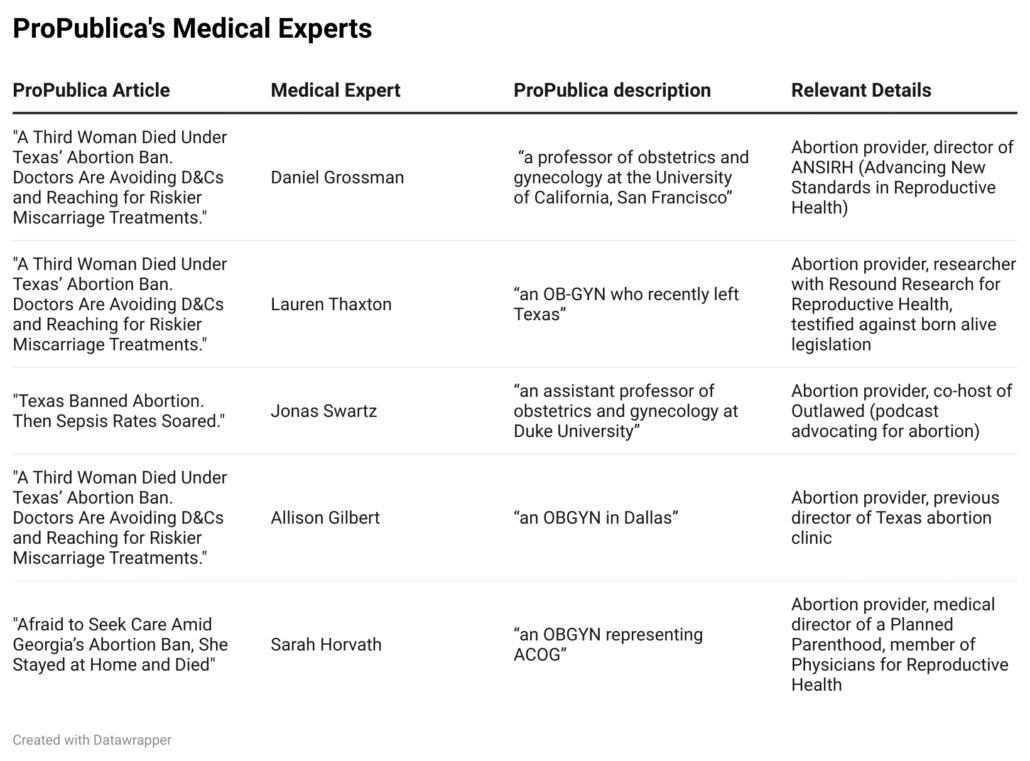
Dr. Daniel Grossman, UCSF professor. (Also director of an international abortion advocacy group.)
In ProPublica’s Ngumezi article, they quote Dr. Daniel Grossman, who they describe as “a professor of obstetrics and gynecology at the University of California, San Francisco.”
This description is true, albeit a little incomplete. Dr. Grossman is the director of ANSIRH (Advancing New Standards in Reproductive Health). ANSIRH is the organization which ran the Turnaway Study, whose well-covered findings are cited as arguments against prenatal protections across the country and around the world. (The Turnaway Study’s overlooked findings are another story.) ANSIRH advocates for removing all gestational limits from abortion law. Grossman himself has argued for making abortion pills available over the counter.
In other words, the OBGYN ProPublica consults is not only an abortion provider, but the director of a major abortion advocacy group. It appears ProPublica’s reporters didn’t consider this context relevant when quoting Grossman in an article about abortion laws.
Presser, Surana, and other ProPublica reporters repeat this pattern throughout their denial-of-care stories: reference medical practitioners without mentioning their history of abortion advocacy. More examples:
Dr. Lauren Thaxton: nondescript OBGYN. (Also abortion provider and abortion-based researcher.)
In their Ngumezi article, ProPublica describes Dr. Lauren Thaxton as an “OB-GYN who recently left Texas.”
Dr. Thaxton is a Colorado abortion provider and a researcher with Resound Research for Reproductive Health, which seeks to examine “strategies that can expand access to this essential part of reproductive healthcare [abortion].” Dr. Thaxton has been writing and advocating for abortion since at least 2016 when she testified against a New Mexico bill aimed to increase inspections of abortion facilities and provide care for infants who survive abortion attempts. (Up to 1 in 10 abortions in New Mexico have happened at 21 weeks gestation or later, compared to an approximate national average of about 1%. See Table 7 here.)
Dr. Jonas Swartz, Duke University professor. (Also abortion provider and co-host of abortion-focused podcast.)
In their Texas sepsis article, ProPublica describes Dr. Jonas Swartz as “an assistant professor of obstetrics and gynecology at Duke University.”
Dr. Swartz is an abortion provider and co-author of publications such as “The Problems with Crisis Pregnancy Centers” and “Why Crisis Pregnancy Centers Are Legal but Unethical.” He also co-hosts the Outlawed podcast, where he’s described as one of two OBGYNs “on the front lines of abortion care.”
Dr. Allison Gilbert. Dallas OBGYN. (Also former director of a Texas abortion clinic.)
In their Ngumezi article, ProPublica describes Dr. Allison Gilbert as “an OBGYN in Dallas.”
Dr. Gilbert is an abortion provider and was, until its closure in 2023, the director of the Southwestern Women’s Surgery Center, a Texas abortion clinic offering abortions up to 21 weeks.
Dr. Sarah Horvath, ACOG representative. (Also medical director of Planned Parenthood.)
In their Miller article, ProPublica describes Dr. Sarah Horvath as “an OBGYN representing ACOG.” Dr. Horvath is an abortion provider currently serving as the medical director for Planned Parenthood Keystone. In 2018, she was profiled in an article about the “new guard” of doctors trying to expand access to abortion. She is a member of Physicians for Reproductive Health, a group of doctors dedicated to advocating for abortion. And she testified to the Pennsylvania legislature in support of amending the commonwealth’s constitution to protect abortion access.
ProPublica persistently omits their experts’ deep ties to abortion advocacy. Leaving out this context misleads readers, and erases the lines between investigative journalisms and pro-abortion storytelling.
If you appreciate our work and would like to help, one of the most effective ways to do so is to become a monthly donor. You can also give a one time donation here or volunteer with us here.