

It’s crucial that we demonstrate that anyone can–and everyone should–oppose abortion. Thanks to you, we are working to change minds, transform our culture, and protect our prenatal children. Every donation supports our ability to provide nonsectarian, nonpartisan arguments against abortion. Read more details here. Please donate today.
A Legal History of Induced Abortion in the United States
/0 Comments/in Biology, Legislation, Laws & Court Cases, Research, Uncategorized /by Daniel GumpA recurring flaw with modern claims about induced abortion legality in early America is that they are seen through the lens of modern medicine. However, in the eighteenth century, there were no ultrasound images, no fetal stethoscopes, no home pregnancy tests, and really no way to reliably confirm pregnancy until a woman could feel movement of the unborn child within the womb – the “quickening.”
The science of embryology did not yet exist. Both the oocyte and the spermatozoon were still foreign concepts. The point at which individual life began was more a philosophical concept than one of medicine and biology. Law at the time reflected this state of contemporary medicine, commonly treating quickening as the demarcation for criminality. Before that threshold, little was understood; after it, the woman was seen as “pregnant with child.”
For this reason, it is undeniably flawed for abortion proponents to use the 1736 John Tennent book Every Man His Own Doctor [1] to support their views. In its American reprint, publisher Benjamin Franklin would have seen the included recipe for “suppression of the courses” to be remedies for irregular menstruation — rather than potentially abortifacients.
English common law had focused for centuries on quickening for the vast majority of crimes. Third-parties causing miscarriage before quickening may treat pregnant women as the victims of misdemeanors, while crimes after quickening were considered homicidal acts against the unborn children.
Founder and Declaration of Independence signatory John Witherspoon gave a lecture series at Princeton on moral philosophy. One lecture covered the “Relation of Parents and Children” [2]. In this, he rebuked those who viewed children as property to be discarded (original emphasis retained):
Induced abortion – that “power of life and death” – was considered a heinous act. Thomas Jefferson echoed the sentiment in his 1787 book, Notes on the State of Virginia [3], about a practice by the Cherokees, he saw as barbaric, contributing to their low population growth:
William Blackstone, Solicitor General to the Queen of England, wrote of induced abortions and fetal homicides in his 1765 English common law compendium, Commentaries on the Laws of England [4]:
Founder and US Supreme Court Justice James Wilson gave a lecture series on law to President George Washington and his cabinet in 1790. One such lecture, “Of the Natural Rights of Individuals,” [5] discussed American inheritance of English common law:
In 1803, Lord Ellenborough’s Act [6] in the United Kingdom created early statutory law related to induced abortions, clearing up ambiguities in common law. While it still used the quickening as demarcation, it declared abortions induced before or with unproven quickness to be felonies with convictions resulting in fourteen years imprisonment. Post-quickening induced abortions were capital crimes equal to murder.
On the medical front, it became common for early nineteenth century physicians to denounce as quacks those who induced abortions. Dr. Samuel Akerly wrote of coercive abortionists in The Medical Repository (1808) [7]:
In the coming years, scientists and physicians began questioning the validity of the quickening. Dr. John Burns expressed such reservations in Burns’s Obstetrical Works (1809) [8]:
Dr. John Beck, vice-president of The Medico-Chirurgical Society, went a step further and expressed absurdity of the quickening in his 1817 work, An Inaugural Dissertation of Infanticide [9]:
In the United States, statutes began arising to clarify ambiguities left in common law. They often mirrored the text of Lord Ellenborough’s Act, focusing on methods of inducing abortions that involved the ingestion of drugs or poisons. The first was legislation came in Connecticut in 1821 [10], in direct response to the weak sentencing after the politically-motivated case against preacher Ammi Rogers [11]. Missouri [12] and Illinois [13] followed with similar statutes (covering the entirety of pregnancy) in the next few years.
The entire state of medicine changed in 1827 with the publication of Karl Ernst von Baer’s Ovi Mammalium et Hominis Genesi [14]. This book shared with the world the discovery of the mammalian ovum. He followed the next year with the comparative embryology book Über Entwickelungsgeschichte der Thiere [15]. These works were so groundbreaking that von Baer is now often called “the father of embryology.”
Immediately, lawmakers in the United States took notice. Within the next decade, pre-quickening statutes on criminal abortion came in New York (1828) [16], Ohio (1834) [17], and Indiana (1835) [18].
Additionally, legislatures of Georgia (1833) [19] and Arkansas (1838) [20] enacted statutes to suspend death sentences for pregnant women until they had given birth.
In the United Kingdom, the 1837 Offences Against the Person Act [21] completely removed any mention of the quickening, something that would soon resonate within the United States.
The Supreme Court of Pennsylvania expressed the rapidly-changing view of the quickening in the 1846 case, Commonwealth v. Demain (1 Brightly 441) [22]:
By mid-century, the stethoscope came into common use, allowing detection of a fetal heartbeat long before many women felt fetal movements. This combined with general advances in medicine led many physicians and medical associations to more directly denounce the growing underground abortion industry.
In 1854, obstetrician Hugh Hodge gave a lecture at the University of Pennsylvania called “On Criminal Abortion,” [23] in which he spoke of the absurdity of the quickening:
By the mid 1850s, more than half of states and territories had criminal abortion statutes, the majority of which defined pre-quickening criminality.
In 1857, the newly-founded American Medical Association convened for a conference in Louisville, Kentucky. Under the leadership of obstetrician and pioneer gynecologist Dr. Horatio Storer, the Committee on Criminal Abortion formed to research the rapidly-growing underground industry. Their report [24] two years later declared (1) there to be widespread ignorance among the general public on induced abortions, (2) a state of carelessness by physicians that leads to unintentional fetal demise, and (3) a failure of laws to recognize civil rights of the unborn. The committee unanimously condemned the crime of abortion and called for (1) educating the general public on fetal development, (2) correcting errors of negligence within their ranks, (3) establishing an obstetrics code, and (4) lobbying efforts for laws to better protect the unborn.
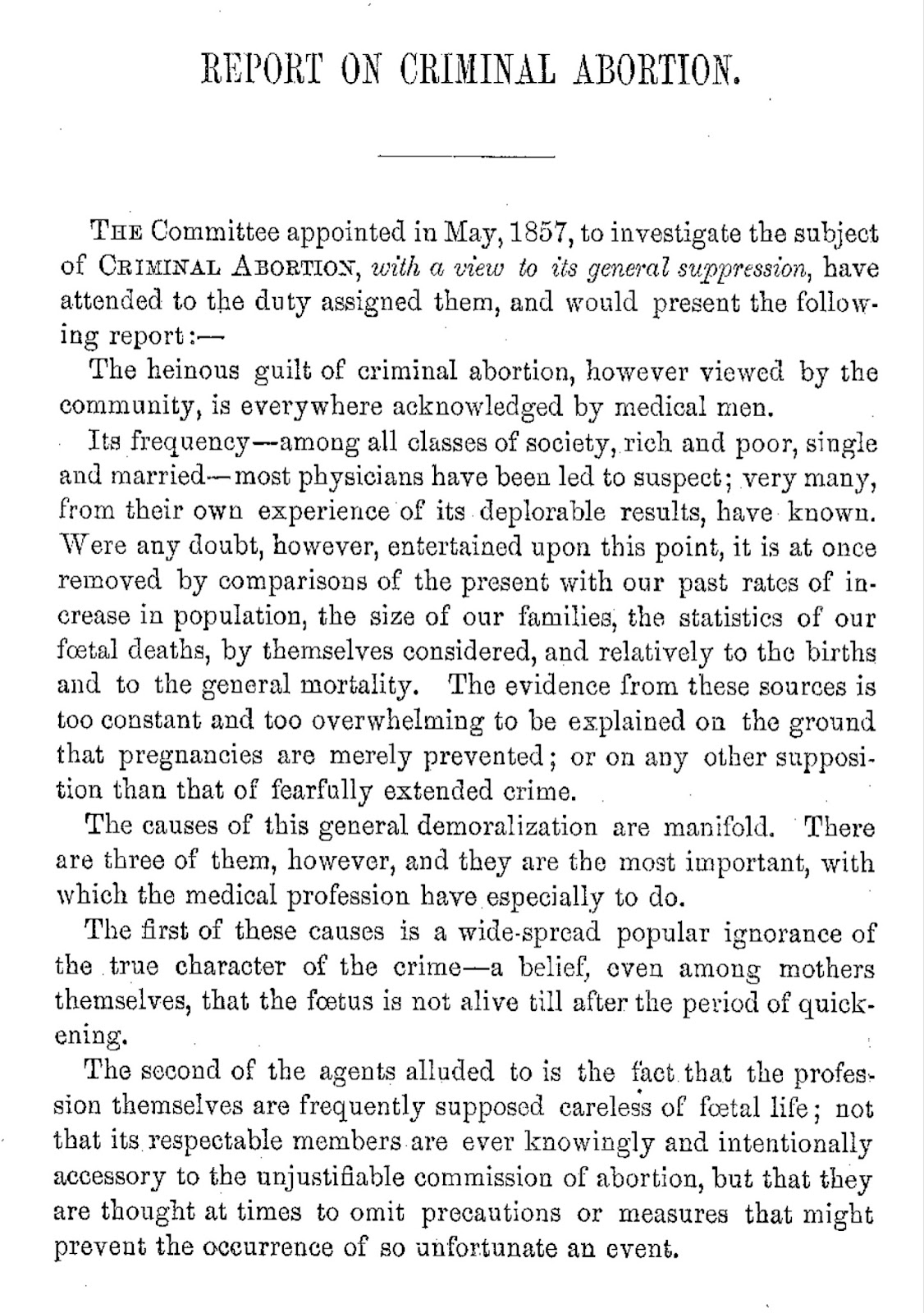
On his own, Storer also wrote and published a number of books and essays regarding criminal abortion [25], fetal development [26], and improved obstetric and gynecological practices.
State medical associations led their own efforts, as well. The Maine Medical Association declared in their 1866 “Report on Production of Abortion” [27] that inducing abortion at any gestational age is morally equivalent to murder. The report included a quotation from Chief Justice John Tenney of the Maine State Judicial Court stating, “the reference to the quickening of the child seems to rest upon no reasonable grounds, and has been abandoned by jurists in all countries where enlightened jurisprudence exists in practice… the procuring of abortion must be treated as a species of murder.”
It was common for these reports to declare that modern medicine had even eliminated any potential necessity to induce abortion to save the mother’s life. Dr. Ed Le Prohon wrote in his 1867 essay “Voluntary Abortion” [28] that the skull-crushing craniotomy abortion was more dangerous in medical emergencies for the mother than Caesarian sections, and Storer had spoken of the horrors of infants surviving such barbaric abortion procedures. Thus, Prohon declared that less-experienced — or even fraudulent — physicians were the only ones to perform them:
During this timespan of the 1850s to 1860s, many state legislatures eliminated references to the quickening in statutes, expanding their former post-quickening laws to cover the entirety of gestation. Among these, Ohio’s 1867 Journal of the Senate [29] included a detailed committee report with the passage:
By the close of the American Civil War, nearly all states and territories had criminal abortion statutes, and about three-quarters of those criminalized the acts before the quickening. [30] Most remaining hold-outs were former Confederate states that would go on to enact their own statutes in the coming decades, when overhauling their legal codes. Every state had criminal abortion statutes by the early twentieth century.
Clearly, the nineteenth century was one of rapid scientific advancements in areas that included embryology, obstetrics, gynecology, and medical technology. With these changes came greater understanding of prenatal development that expanded into the legal realm and relegated the premise of the quickening into the pseudoscientific realm. As common law could not keep pace with rapid changes, statutory law overtook it as the means of defining criminality of induced abortions.
From a twenty-first century vantage point, one can lose perspective of just how much changed in such little time, providing the foundation for concepts that seem elementary by today’s standard. Yet, historical evidence shows that from the founding of the United States, the intent was always to protect the lives of unborn children from the moment their existences became known. Thus, to argue today that induced abortions are not killing living human beings, one must rely on science that has been outdated for nearly two centuries.
[Today’s guest article is by Daniel Gump.]
—
Pro-Life Pride!
/0 Comments/in Pro-Life Demographics, Uncategorized /by Kelsey HazzardHappy pride month! To honor the occasion, here’s a few of our favorite pro-life LGBT+ accounts to follow. Feel free to add more in the comments.
Aimee Murphy: @rehumanizeaimee
Andrew Bair: @ProLifePolitics
Herb Geraghty: @HerbGeraghty
Lauren Handy: @repreaux
Hayden Lane: @ProLifeLGBTQ
LGBTQ and Pro-Life: @LGBTQProLife
PLAGAL+ (formerly known as the Pro-Life Alliance of Gays and Lesbians): @PLAGALofficial
Rehumanize International (LGBT+ leadership): @rehumanizeintl
The Future is Anti-Abortion. So is the Present.
/0 Comments/in Pro-Life Demographics, Rape Exception, Research, Uncategorized /by Kelsey HazzardIn a recent article in the Atlantic, Jerusalem Demsas asks an important question: “Now that the Supreme Court seems poised to reverse itself on Roe v. Wade, abortion-rights advocates and anti-abortion advocates are both claiming the mantle of popularity. Who’s right?”
Spoiler alert: we are.
Demsas, who is pro-abortion, takes a while to get there and reaches her truthful conclusion reluctantly. Most Americans shy away from blanket permissions and bans, preferring a policy that only allows abortion “under certain circumstances.” Specifically, “Americans are sympathetic to women seeking abortions if they are victims of rape or incest, if they have a serious health concern, or if the baby will be born with a disability. They are significantly less likely to approve of abortion in cases of economic hardship or personal preference.” Support for such abortions hovers below 50%, according to multi-year polling Demas cites from the University of Chicago.
The overwhelming majority of abortions fall in the unpopular categories. Financial concerns account for nearly three quarters of abortions, according to Guttmacher Institute; personal reasons such as “having a baby would dramatically change my life” are also very common. The so-called “hard cases” of rape (1%) and incest (0.5%) are simply not frequent enough to keep an abortion clinic profitable.
That most Americans oppose most abortions is great news, of course. We should be replying to every dishonest NARAL tweet with a link to the Atlantic article. But let’s not declare victory just yet. The continued majority support for killing in response to a prenatal diagnosis is extremely disturbing. An end to ableism must remain high on the pro-life agenda. We must also keep in mind that Demsas is citing national averages; as long as the abortion industry can find concentrated support in particular regions of the country (e.g. New York and California), babies are at risk. Dobbs represents a new era of state-by-state, city-by-city organizing. How will you contribute?
[Photo credit: Students for Life of America]