

“Period pills” are abortion pills for people who don’t want abortions
If you want the physical effects of abortion without the psychological impacts, there’s a pill for that.
(For all quotes below, emphasis is added.)
The journal Contraception published Interest in period pills in the United States: A nationally representative survey, 2021–2022. The study was conducted primarily by researchers from Advancing New Standards in Reproductive Health (ANSIRH), the research program that brought us The Turnaway Study. They surveyed over 6000 people and found about a fourth were interested in personally taking period pills, and over half thought period pills should be available.
So what are period pills?
Period pills are a method used to induce bleeding when a menstrual period is late and pregnancy is suspected but not confirmed. Period pills (also sometimes called late period pills or missed period pills) could be offered as an additional service distinct from abortion…
Interest in period pills in the United States, Upadhyay et al
But what are period pills? What is the active ingredient involved?
Period pills can consist of misoprostol, either alone or with mifepristone.
Interest in period pills in the United States, Upadhyay et al
That’s a weird coincidence. That’s what abortion pills consist of.
So what’s the difference between period pills and abortion pills?
A key distinction between period pills and medication abortion is the absence of a pregnancy test before taking the medications.
Interest in period pills in the United States, Upadhyay et al
In other words, period pills are abortion pills. They are literally the same pills. The distinction is the circumstances under which someone takes them.
So I could suspect I’m pregnant, get some period pills, and then take a pregnancy test. Then, bam, the period pills would turn into abortion pills. How magical.
Did survey respondents understand they were answering questions about abortion pills? Seems unlikely. Here is the description of “late period pills” respondents received:
In the future, people may be able to take “late period pills” to bring back a period. Instead of taking a pregnancy test, people could take these pills to bring on bleeding like a period. The pills would be safe and could cause period-like symptoms, such as bleeding, cramping, and nausea. If you were pregnant, the pills would almost always end the pregnancy.
Interest in period pills in the United States, Upadhyay et al
The description doesn’t mention mifepristone, misoprostol, or abortion. Researchers then asked “What are some possible advantages of having ‘late period pills’ available?” Here are the responses:
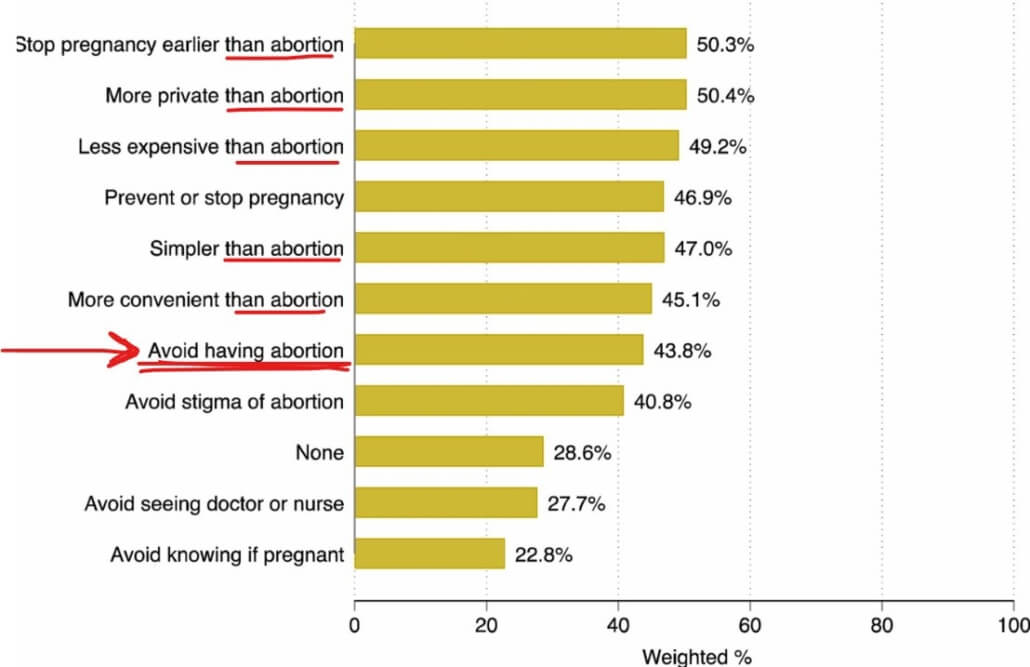
The most popular answers were:
- Stop pregnancy earlier than abortion
- More private than abortion
- Less expensive than abortion
Respondents listed advantages of period pills based on how they differ from abortion, suggesting respondents likely didn’t realize period pills cause abortions. In fact 43.8% of respondents said an advantage of period pills was the ability to avoid having an abortion. Other cited advantages included “simpler than abortion,” “more convenient than abortion,” and “avoid stigma of abortion.”
People like the idea of period pills because they think these are alternatives to abortion, and not abortion itself. The ignorance is a feature, not a bug.
42% of patients would be interested in a “missed period pill,” when defined as “pills that could be taken if you had missed your period and did not want to know if you were actually pregnant.” Reasons for interest included psychological or emotional benefits, such as “less moral conflict,” “less guilt,” to avoid knowing if one was terminating a pregnancy…
Interest in period pills in the United States, Upadhyay et al
Nothing says “informed choice” like deliberately avoiding information.
So if you think you’re pregnant and don’t want to be—but you don’t want an abortion—there’s a solution in two easy steps.
- Be careful not to take a pregnancy test, and
- Be careful to call mifepristone and misoprostol “period pills,” not “abortion pills.”
Congratulations. You may or may not have been pregnant, and you may or may not have had an abortion. The important thing is you’ll never really have to know—and isn’t that what essential healthcare is all about?