
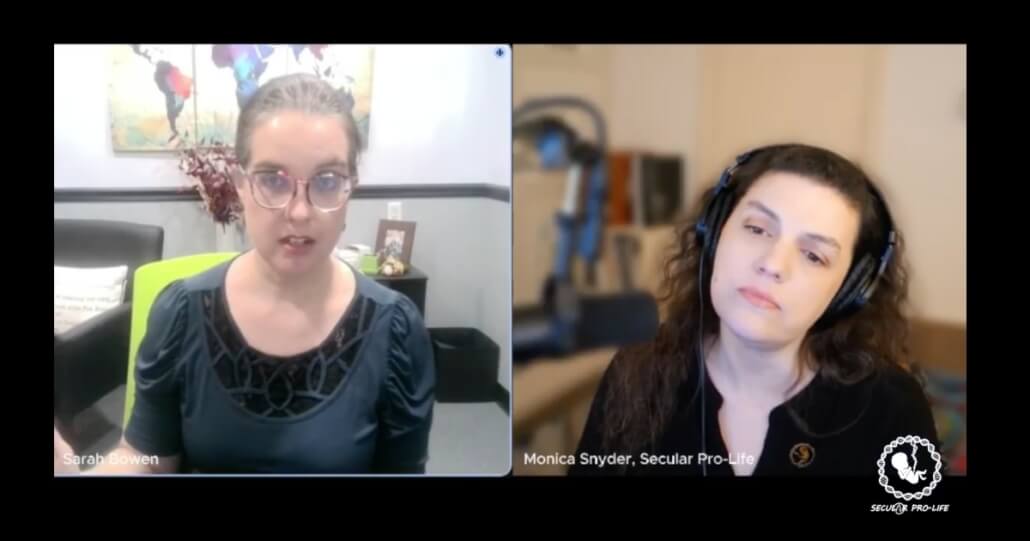

Interview with Sarah Bowen: “Every single appointment abortion comes up”
I interviewed Sarah Bowen, Executive Director of Promise of Life Network, about her own high-risk pregnancy with twin boys, particularly about her experience with different medical teams after her water broke at 15 weeks. You can watch the full conversation here or read a summary below.
You can also access this recording on Spotify. If you listen to the full episode and have feedback, please tell us here.
Key Takeaways
- Medical pressure to abort can be persistent, even when patients clearly decline.
- Medical counseling may depend on specialty; Sarah found maternal fetal medicine specialists the least supportive, and neonatologists more helpful.
- There are many opportunities for communication breakdown between medical professionals and their patients in emotionally fraught situations.
Summary
“Every single appointment abortion comes up. Every single appointment.”
Sarah was pregnant with twin boys when her water broke at 15 weeks. Doctors gave one twin almost no chance of survival, and the other low odds. From the start, Sarah was explicit that she didn’t want an abortion, but maternal-fetal medicine specialists raised the option repeatedly during later appointments.
When Sarah was admitted to the hospital at 22 weeks, a doctor approached her three separate times (each when Sarah’s husband was out of the room), first offering to abort both twins, then suggesting selective reduction of one twin, and finally asking whether Sarah would allow an abortion if the doctor could prove one twin had a severe genetic abnormality. She refused each time and eventually ordered the doctor to leave and not return. Sarah was left feeling she needed to protect her unborn sons from hospital staff she should have been able to trust to help her.
Sarah’s twins were both delivered via c-section at 24 weeks and 4 days, and after extended stays in the hospital, went home with their family.
“It was always the maternal fetal medicine doctors.”
Sarah emphasized that overall she received excellent care from obstetrics and neonatology teams, but she found maternal fetal medicine doctors to be “very abortion focused.” Now she tells everyone that if they have a high-risk pregnancy, they should be sure to talk to a neonatologist, who can tell parents what to expect once the baby is born.
Often when parents receive a prenatal diagnosis, they’re offered abortion first, and only after they (sometimes persistently) decline are they offered a referral to neonatology. Informed consent and an even-handed discussion of all options should involve the opposite sequence of events: let parents talk to experts about their child’s condition before pushing them to decide whether they want to terminate.
“There’s a lot of communication breakdown, most of it accidental, but not all of it.”
Sarah’s story demonstrates the many points during which communication can break down between medical professionals and their patients. Doctors don’t always explain uncertainty levels or false positive rates of their tests. They may not walk patients through their decision-making processes. Even when doctors try to explain things carefully, they’re trying to translate complicated medical information to people who don’t have their training, often during moments of fear and stress. Clear communication is difficult even for doctors who try to center patient decisions, and gets much worse when they don’t.
Interview Chapters
0:00 — Why we’re telling these stories
2:05 — Embryo adoption and twins
3:42 — “I don’t want to talk about abortion”
6:27 — Abortion keeps coming up
8:25 — “Talk to a neonatologist”
13:30 — Hospital admission
17:10 — Abortion Offer #1: Abort both twins
21:26 — Abortion Offer #2: Abort one twin
28:41 — Abortion Offer #3: Abort one twin if there’s a genetic anomaly
34:01 — Emergency c-section
40:13 — Hospitals are willing to protect NICU babies
45:25 — The history of medical coercion after prenatal diagnosis
47:04 — The “ideal abortion decision”
57:09 — What counts as abortion?
59:16 — Supporting mothers who want to carry to term
Additional Resources
Bioethics article
“What is Abortion?” survey
Prenatal Diagnoses collection
Prenatal Diagnoses survey
If you appreciate our work and would like to help, one of the most effective ways to do so is to become a monthly donor. You can also give a one-time donation here or volunteer with us here.