
How pro-lifers and pro-choicers define abortion: results from SPL’s survey
Since conducting this survey, Herb Geraghty and I streamed an in-depth conversation about some of the survey results and what they mean for our public discourse. Get the replay link here:
Introduction
There’s no single definition of “abortion.” We can define it in terms of ethics, law, or medicine, and each definition may differ. Even within one scope of practice (medicine, in the following examples), there are different concepts of abortion, particularly regarding which gestational ages the term applies to. For example:
- Harvard Medical School – Abortion is the removal of pregnancy tissue, products of conception or the fetus and placenta (afterbirth) from the uterus.
- Yale School of Medicine – Abortion is the termination of a pregnancy before the fetus can survive outside the uterus. It can occur spontaneously, known as a miscarriage, or be induced intentionally through medical or surgical procedures.
- UpToDate: Abortion “refers to pregnancy loss up to 20 weeks (sometimes called spontaneous abortion) or pregnancy termination at any gestational age”
Pro-choice organizations tend to define the term broadly, without distinguishing reasons, outcomes, gestational ages, etc.
- Planned Parenthood – Abortion is a safe way to end pregnancy.
- ACOG – “What is abortion?” Induced abortion ends a pregnancy with medication or a medical procedure.
- ANSIRH – Medication abortion is a safe and effective way to end a pregnancy with pills.
Pro-life organizations tend to define “abortion” to include intent (emphasis added):
- AAPLOG – Elective abortion is defined as those drugs or procedures used with the primary intent to end the life of the human being in the womb.
- Charlotte Lozier Institute – Induced abortion is defined as an action taken to terminate a pregnancy with the intent that the unborn child die and that a live birth does not result
Of course most people aren’t reading the definitions of pro-choice and pro-life advocacy orgs. When the average person hears the word “abortion,” what do they think it means?
Sort of digging into that question, in October 2023, Social Science Medicine published “Technically an abortion”: Understanding perceptions and definitions of abortion in the United States. The researchers presented survey participants with descriptions of pregnancy scenarios and asked the participants whether the scenarios were abortions. Participants could answer “yes, definitely,” “no, definitely not,” “maybe, it depends,” and “I don’t know.”
This survey was a cool concept, but the descriptions of pregnancy scenarios were sometimes a little vague, which means the participants’ answers were less enlightening. For example, participants were supposed to indicate whether someone who “had an ectopic pregnancy” had an abortion. Are they asking if the existence of ectopic pregnancy is an abortion? It’s just a strange way to ask the question. Similarly, participants were supposed to indicate whether someone who “had a procedure to end a pregnancy at a doctor’s office” had an abortion. What procedure? There are multiple ways to end a pregnancy, some of which result in a live birth. Details could change the responses.
I liked the concept but wanted more information. That’s why I designed SPL’s “What is an ‘abortion’?” survey.
Survey design
Categories
SPL’s survey describes 32 scenarios divided into the following nine categories of interventions:
- Treatments for ectopic pregnancy
- Mifepristone/Misoprostol
- D&C
- Previable labor induction
- Previable D&E
- Premature labor induction for live birth
- Induced fetal demise and labor induction
- C-sections, and
- Scenarios which involve no medical intervention
I tried to design the scenarios to explore how people intuitively respond to situations involving things like fetal death, medical emergencies, different stages of pregnancy, and other factors that might shape their understanding of what qualifies as an “abortion.”
Descriptions
For each of the above nine categories, I provided some basic definitions before presenting the scenarios. I didn’t want these descriptions to bias anyone to view a given scenario as an abortion or not, so after I wrote each definition, I asked a friend of mine who is passionately pro-choice to tell me if she thought the descriptions were objective. We went back and forth a little and tweaked each definition until we both agreed it was fair. These are the definitions I ultimately included with the survey:
1. Treatments for Ectopic Pregnancy
- Embryo is the early stage of human development from fertilization until the 8th week of pregnancy. This is when major organs are forming.
- Ectopic pregnancy is when an embryo has implanted abnormally, most commonly in the fallopian tube. If the embryo isn’t removed and continues to grow, the fallopian tube can rupture, leading to life-threatening bleeding.
- Fallopian tubes are the pair of thin tubes connecting a woman’s ovaries to her uterus.
- Methotrexate is a pharmaceutical agent used to treat ectopic pregnancies. It works by stopping the embryo’s cells from growing, leading to the embryo’s death. Over time, the woman’s body will absorb the embryonic tissue.
2. Mifepristone/Misoprostol
- Fetus is the stage of human development after the embryo stage, lasting from the beginning of the 9th week of pregnancy until birth. Major organs have taken shape and continue to grow and develop.
- Mifepristone is a pharmaceutical agent that blocks the hormone progesterone, causing the lining of the uterus to break down and the embryo or fetus to detach from it.
- Misoprostol is a pharmaceutical agent which induces labor (causes the uterus to contract), helping to push an embryo or fetus out of the woman’s body.
- These two combined are commonly referred to as abortion pills, medication abortion, or chemical abortion, although each agent can be used for other medical purposes.
3. D&C
- D&C stands for Dilation & Curettage. It is a surgical procedure typically involving (1) gradually widening (dilating) the cervix to allow access to the uterus and then (2) using suction to remove tissue from the lining of the uterus.
- Polyp is a growth that forms on the inner lining of the uterus. They’re usually not harmful, but can sometimes cause symptoms and can rarely become cancerous.
4. Previable labor induction
- Previable means the fetus is not yet developed enough to survive outside the womb. For the purposes of this survey, assume the following questions are for fetuses between 15 and 20 weeks gestation.
- Labor induction is when a woman is induced to give birth before she goes into labor naturally. This can be done with medications or specific procedures.
- Adverse prenatal diagnosis is the detection of a serious health condition or abnormality in the fetus during pregnancy. Some such situations will mean the fetus will not survive until birth or will not survive long after birth. Other situations will mean the fetus could survive well past birth, but may have challenges specific to different disabilities.
- Maternal health emergency means a situation in which the pregnant woman’s life or physical health (rather than the fetal life or health) is threatened.
5. Previable D&E
- D&E stands for Dilation & Evacuation. It is a procedure involving (1) gradually widening (dilating) the cervix to allow access to the uterus and then (2) using surgical instruments to remove (evacuate) the fetus and placenta from the uterus. D&E is distinct from D&C in that D&C only uses suction and wouldn’t be effective at removing larger more developed fetuses in the second trimeser. D&E more commonly involves removing the fetus in pieces than intact.
6. Premature labor induction for live birth
- Premature refers to the phase in pregnancy after viability but before 37 weeks of gestation. Depending on the gestational age, a premature infant may be viable but still require medical assistance to survive and to thrive.
- NICU stands for Neonatal Intensive Care Unit. It’s a specialized unit of a hospital designed to care for premature and critically ill newborns.
- Comfort care focuses on providing comfort and relief in end-of-life situations without trying to cure any medical conditions.
7. Induced fetal demise and labor induction
- Induced fetal demise refers to a procedure used to intentionally cause the death of a fetus before delivery. Most commonly the procedure involves injecting pharmaceutical agents to stop the fetal heartbeat.
8. C-sections
- A C-section, or cesarean section, is a surgical method of delivering a baby. Rather than the baby being delivered through the vaginal canal, the procedure involves making an incision in the mother’s abdominal wall and uterus to remove the baby.
- For this section, an emergency c-section is one done when there is a medical emergency.
9. No medical intervention
- Miscarriage is the natural death of an embryo or fetus before the 20th week of pregnancy.
- Stillbirth is the natural death of a fetus after the 20th week of pregnancy often during labor or just before delivery.
- Premature infant is an infant born after viability but before 37 weeks of pregnancy. The infant may require medical assistance to survive and to thrive.
- Full term infant is an infant born at or after 37 weeks of pregnancy.
Questions
For every scenario the survey asks two multiple choice questions:
1. Is this an abortion?
- Yes, this is an abortion
- It depends. This may or may not be an abortion.
- No, this is not an abortion.
2. Is this ethical?
- Yes, this is ethical.
- It’s not ethical or unethical. It’s not an ethical issue.
- No, this is unethical.
Note: If we were to conduct the survey again, I would add a fourth option to the ethical question: “It depends. This may or may not be ethical.” This would have made it parallel to the first question.
At the end of each of the nine categories, the survey also has a section for free form input that says “If you’d like to explain your thoughts regarding the [whichever category] scenarios, please do so here.”
Finally, In order to compare the perspectives of pro-life versus pro-choice people, we also asked two identifier questions. First we asked respondents to describe themselves on a 5-point scale, with 1 being “very pro-choice” and 5 being “very pro-life.” Then we asked respondents to choose which comes closest to their view:
- Abortion should be legal in all circumstances.
- Abortion should be legal in most circumstances.
- Abortion should be legal in only a few circumstances.
- Abortion should not be legal in any circumstances.
Data limitations
There are two ways the sample set for this survey is limited.
First, the sample set of pro-choice respondents was small. Only 46 respondents described themselves as pro-choice. Small sample sets make it easier to get extreme or unusual results. If even 1 of 46 respondents expressed a view, it would register in the following graphics as if 2% of pro-choice people hold that view. That may or may not be true. It’s probable that if several hundred pro-choice people had taken the survey, there would be fewer outlier views showing up in the data.
Second, the entire sample set is drawn from the kinds of people who follow Secular Pro-Life on social media. Both pro-life and pro-choice people who care enough about abortion to follow social media accounts related to it may differ in significant ways from average Americans who describes themselves as “pro-life” or “pro-choice.” I suspect that, compared to the average American, SPL’s social media followers are more passionate about abortion and have given it more thought, which may change how they answer the survey questions.
All this to say: take the results I’m about to share in context. They aren’t meant to be a rigorous or reproducible scientific endeavor. They’re just a starting point to help us think about how different groups might see abortion in different ways. I hope they lead to good questions and better conversations.
Want to try the survey yourself before you read the results? Take it here:
Results
We published the survey in November 2024, and from 11/20/24 through 12/7/24 we received 794 responses.
We asked respondents to rate their views on abortion on a five point scale, with 1 being “very pro-choice” and 5 being “very pro-life.” In total, 18 rated their views as a 3 (neutral), 46 rated their views as either 1 or 2 (pro-choice), and 730 rated their views as either 4 or 5 (pro-life). When asked to describe their views on the legality of abortion, 62 responded that abortion should be legal in most or all circumstances, and 732 responded that abortion should be legal in only a few circumstances or not legal in any circumstances.
Which scenarios are abortions?
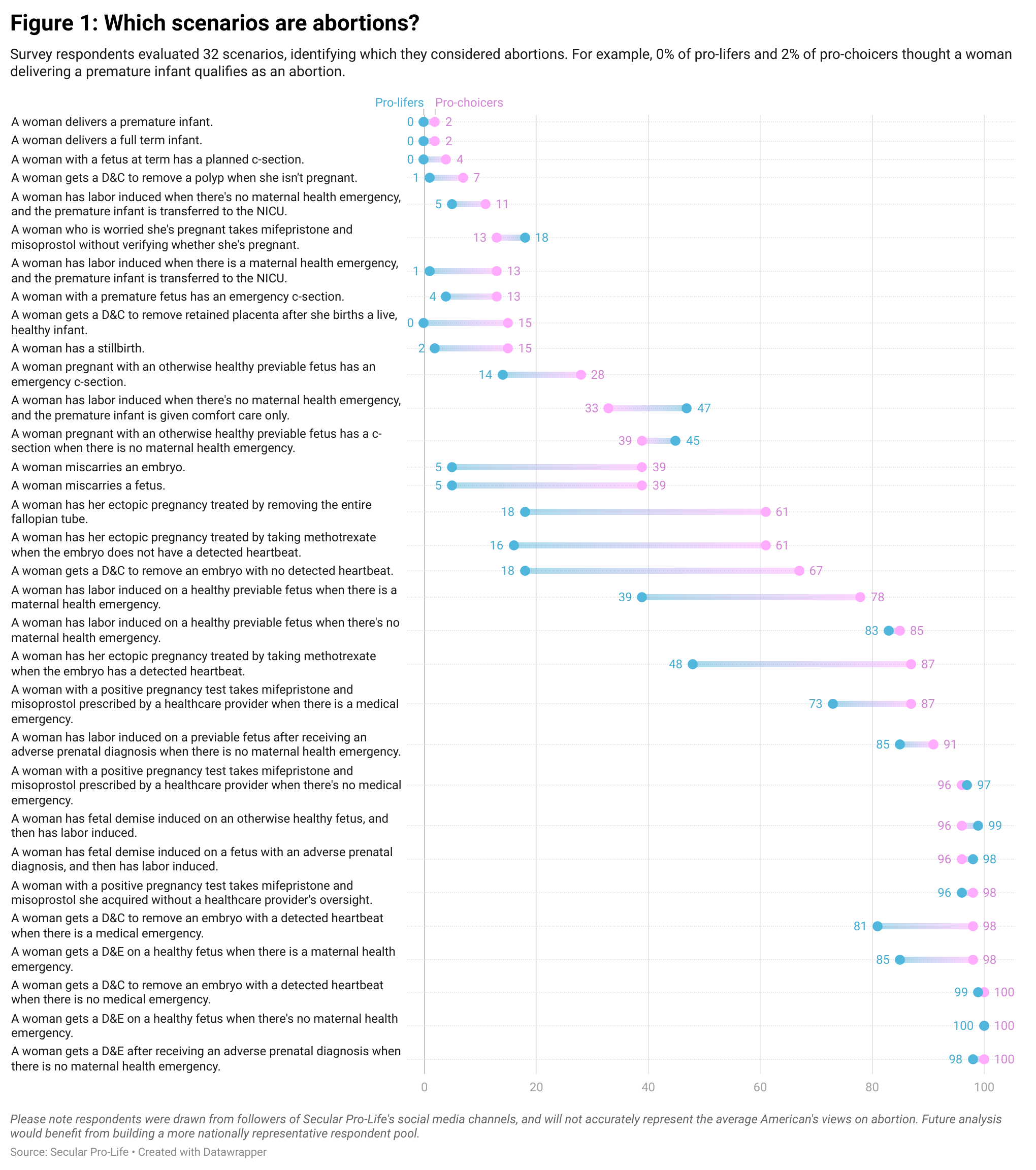
To compare pro-choice and pro-life answers, I calculated the percent of respondents saying “Yes, this is an abortion” out of the total pool of either pro-choice (n=46) or pro-life (n=730) respondents. For example, in response to the scenario “A woman has her ectopic pregnancy treated by removing the entire fallopian tube,” 28 of 46 pro-choice people and 131 of 730 pro-life people said “Yes, this is an abortion,” so Figure 1 represents that data as 18% of pro-lifers and 61% of pro-choicers agreeing the scenario is an abortion.
I said pro-life and pro-choice people agree if their “yes, this is an abortion” answers were less than 10 points apart. If the difference was 10 to 20 points, I said they somewhat disagree. If it was more than 20 points, I said they strongly disagree.
Scenarios both sides agree are not abortions
More than 80% of both pro-life and pro-choice people did not categorize the following scenarios as abortions.
- A woman delivers a premature infant.
- A woman delivers a full term infant.
- A woman with a fetus at term has a planned c-section.
- A woman gets a D&C to remove a polyp when she isn’t pregnant.
- A woman has labor induced when there’s no maternal health emergency, and the premature infant is transferred to the NICU.
- A woman with a premature fetus has an emergency c-section.
Note: Both groups also did not categorize “A woman who is worried she’s pregnant takes mifepristone and misoprostol without verifying whether she’s pregnant” as an abortion, but this is because majorities of both groups selected “It depends” rather than “No, this is not an abortion.”
Scenarios both sides agree are abortions
More than 80% of both pro-life and pro-choice people categorized the following scenarios as abortions.
- A woman gets a D&E on a healthy fetus when there’s no maternal health emergency.
- A woman gets a D&C to remove an embryo with a detected heartbeat when there is no medical emergency.
- A woman with a positive pregnancy test takes mifepristone and misoprostol prescribed by a healthcare provider when there’s no medical emergency.
- A woman has labor induced on a healthy previable fetus when there’s no maternal health emergency.
- A woman gets a D&E after receiving an adverse prenatal diagnosis when there is no maternal health emergency.
- A woman with a positive pregnancy test takes mifepristone and misoprostol she acquired without a healthcare provider’s oversight.
- A woman has fetal demise induced on a fetus with an adverse prenatal diagnosis, and then has labor induced.
- A woman has fetal demise induced on an otherwise healthy fetus, and then has labor induced.
- A woman has labor induced on a previable fetus after receiving an adverse prenatal diagnosis when there is no maternal health emergency.
Scenarios where pro-life and pro-choice people somewhat disagree
Most pro-life and pro-choice people did not categorize the following as abortions, however their responses were still somewhat different. In every case pro-choice people were more than 10 points more likely than pro-life people to say the scenarios were abortions.
- A woman has labor induced when there is a maternal health emergency, and the premature infant is transferred to the NICU.
- A woman has a stillbirth.
- A woman pregnant with an otherwise healthy previable fetus has an emergency c-section.
- A woman gets a D&C to remove retained placenta after she births a live, healthy infant.
In contrast, most pro-life and pro-choice people did categorize the following as abortions, but again their responses differed, with pro-choice people more than 10 points more likely to say these scenarios were abortions.
- A woman gets a D&E on a healthy fetus when there is a maternal health emergency.
- A woman with a positive pregnancy test takes mifepristone and misoprostol prescribed by a healthcare provider when there is a medical emergency.
- A woman gets a D&C to remove an embryo with a detected heartbeat when there is a medical emergency.
Finally, for the scenario “A woman has labor induced when there’s no maternal health emergency, and the premature infant is given comfort care only,” pro-lifers were 14 points more likely than pro-choicers to say “Yes, this is an abortion.” However both groups had higher uncertainty about the situation, with 21% of pro-lifers and 28% of pro-choicers responding “It depends.” Less than 50% of both groups picked either “Yes” or “No” for this scenario.
Scenarios where pro-life and pro-choice people strongly disagree
Most pro-life and pro-choice people did not consider the following abortions, but their responses were very different. Only 5% of pro-lifers said these were abortions, compared to 39% of pro-choicers.
- A woman miscarries an embryo.
- A woman miscarries a fetus.
Most pro-choice people categorized the following as abortions, while pro-lifers were unsure (less than 50% of pro-lifers answered a definitive “Yes” or “No”).
- A woman has her ectopic pregnancy treated by taking methotrexate when the embryo has a detected heartbeat.
- A woman has labor induced on a healthy previable fetus when there is a maternal health emergency.
Finally, most pro-choice people categorized the following as abortions and most pro-lifers did not.
- A woman has her ectopic pregnancy treated by removing the entire fallopian tube.
- A woman has her ectopic pregnancy treated by taking methotrexate when the embryo does not have a detected heartbeat.
- A woman gets a D&C to remove an embryo with no detected heartbeat.
Which scenarios were respondents uncertain about?
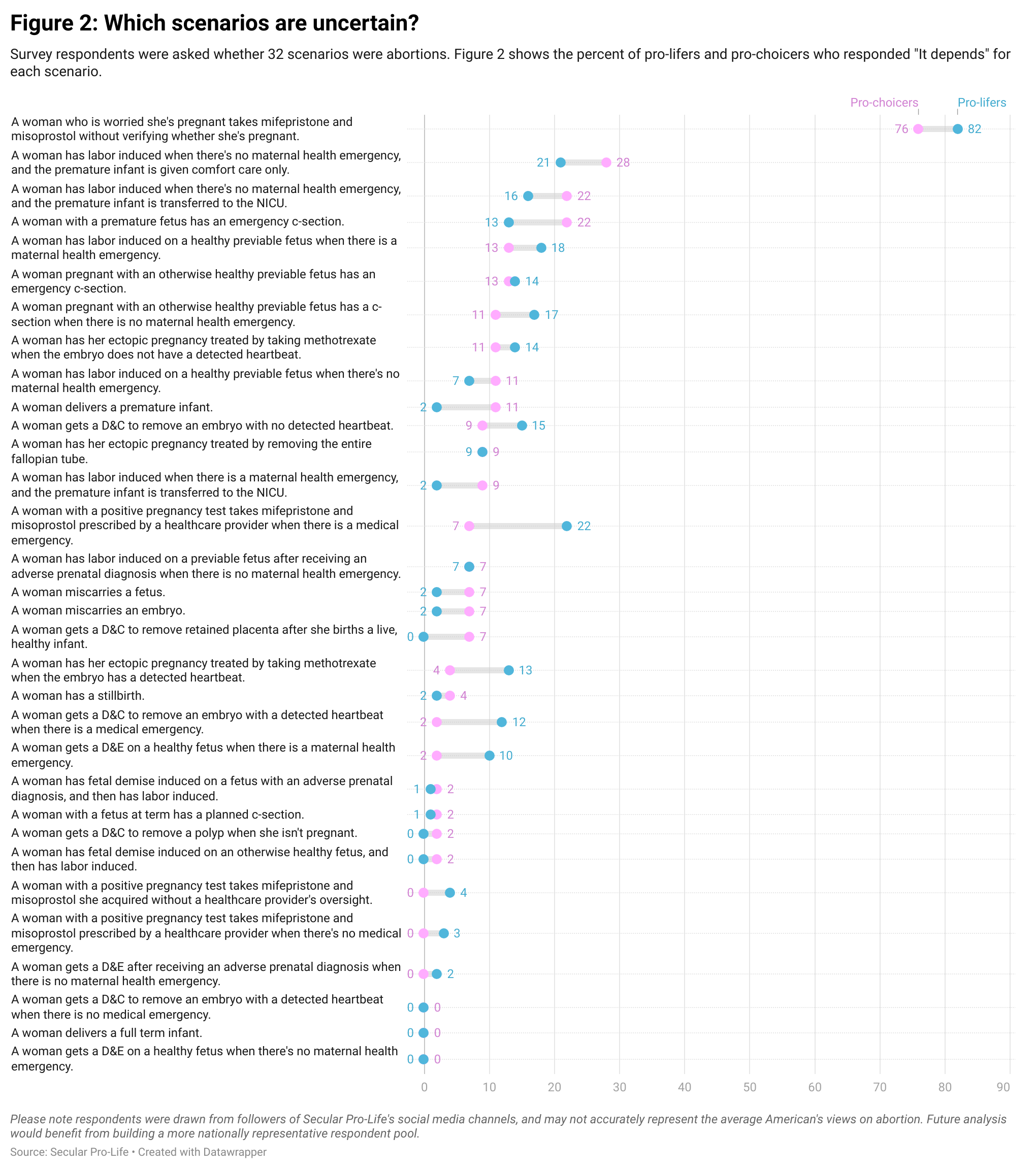
To get some idea of people’s certainty about whether a scenario was an abortion, the survey included the option for respondents to say “It depends.” Figure 2 shows what percent of both pro-life and pro-choice people declined to categorize a scenario as an abortion or not an abortion, and instead said “It depends. This may or may not be an abortion.”
Scenarios where both sides are very uncertain
Majorities of both pro-choice (76%) and pro-life (82%) people responded “It depends” to the scenario “A woman who is worried she’s pregnant takes mifepristone and misoprostol without verifying whether she’s pregnant.”
For all other scenarios, most respondents chose either “Yes, this is an abortion” or “No, this is not an abortion,” rather than “It depends.”
Scenarios where both sides are very certain
Less than 5% of both pro-life and pro-chocie people responded “It depends” to the following scenarios:
Scenarios neither side considered abortions:
- A woman delivers a full term infant.
- A woman with a fetus at term has a planned c-section.
- A woman gets a D&C to remove a polyp when she isn’t pregnant.
- A woman has a stillbirth.
Scenarios both sides considered abortions:
- A woman has fetal demise induced on a fetus with an adverse prenatal diagnosis, and then has labor induced.
- A woman has fetal demise induced on an otherwise healthy fetus, and then has labor induced.
- A woman with a positive pregnancy test takes mifepristone and misoprostol prescribed by a healthcare provider when there’s no medical emergency.
- A woman with a positive pregnancy test takes mifepristone and misoprostol she acquired without a healthcare provider’s oversight.
- A woman gets a D&E on a healthy fetus when there’s no maternal health emergency.
- A woman gets a D&C to remove an embryo with a detected heartbeat when there is no medical emergency.
- A woman gets a D&E after receiving an adverse prenatal diagnosis when there is no maternal health emergency.
Which scenarios are unethical?
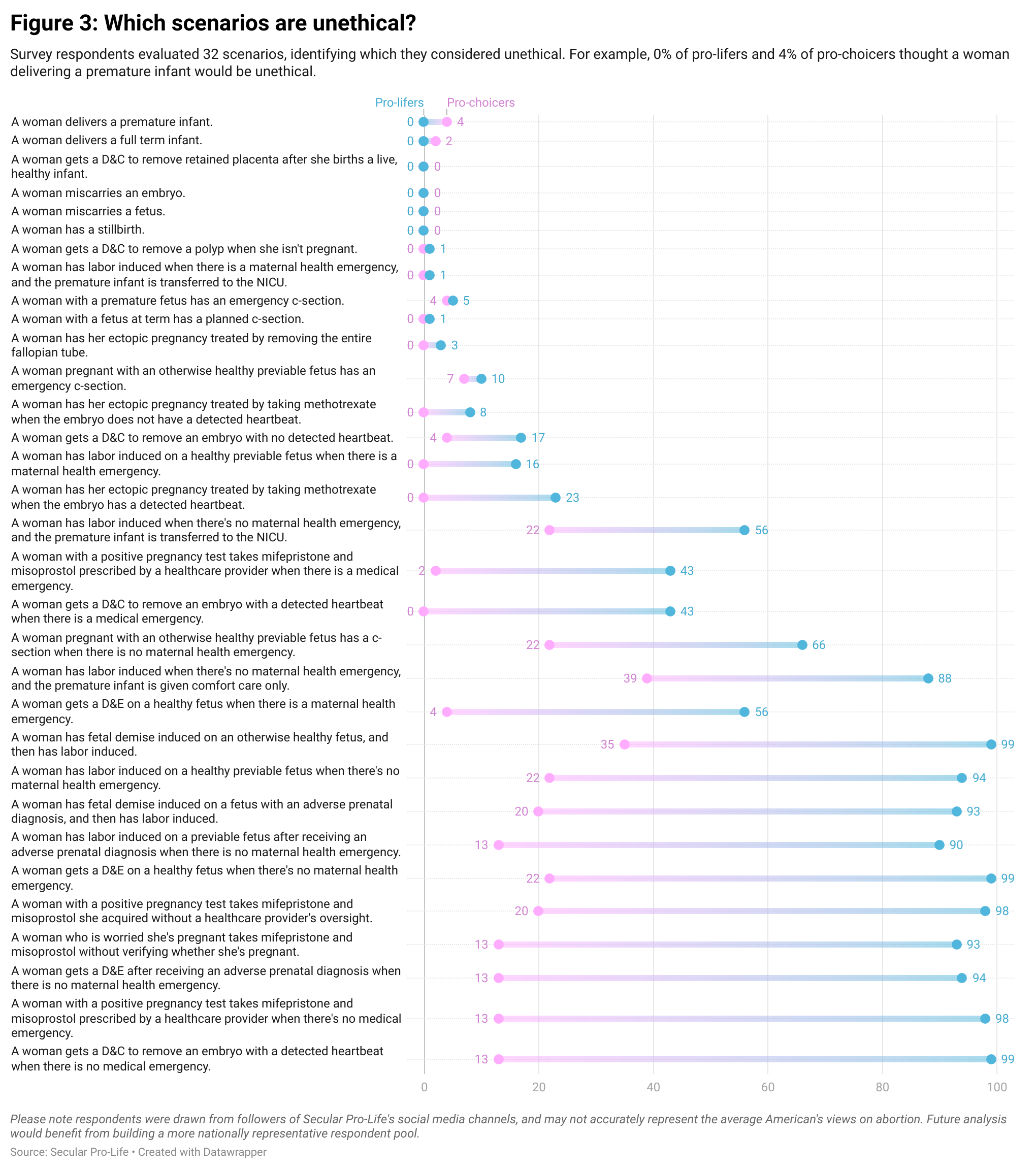
Similar to Figures 1 and 2 above, in Figure 3 you can see the percent of respondents who categorized a given scenario as unethical out of the total pool of either pro-choice (n=46) or pro-life (n=730) respondents.
In general, pro-choicers were far less likely to say a scenario was unethical than pro-lifers.
Scenarios both sides thought weren’t unethical
Less than 5% of both pro-life and pro-choice people categorized the following scenarios as unethical:
- A woman miscarries a fetus.
- A woman with a premature fetus has an emergency c-section.
- A woman gets a D&C to remove retained placenta after she births a live, healthy infant.
- A woman miscarries an embryo.
- A woman has a stillbirth.
- A woman gets a D&C to remove a polyp when she isn’t pregnant.
- A woman has labor induced when there is a maternal health emergency, and the premature infant is transferred to the NICU.
- A woman with a fetus at term has a planned c-section.
- A woman delivers a full term infant.
- A woman has her ectopic pregnancy treated by removing the entire fallopian tube.
- A woman delivers a premature infant.
Scenarios more (but not most) pro-choicers thought were unethical
More than 20% of pro-choicers categorized the following scenarios as unethical:
- A woman has fetal demise induced on a fetus with an adverse prenatal diagnosis, and then has labor induced.
- A woman with a positive pregnancy test takes mifepristone and misoprostol she acquired without a healthcare provider’s oversight.
- A woman has labor induced when there’s no maternal health emergency, and the premature infant is transferred to the NICU.
- A woman pregnant with an otherwise healthy previable fetus has a c-section when there is no maternal health emergency.
- A woman has labor induced on a healthy previable fetus when there’s no maternal health emergency.
- A woman gets a D&E on a healthy fetus when there’s no maternal health emergency.
- A woman has fetal demise induced on an otherwise healthy fetus, and then has labor induced.
- A woman has labor induced when there’s no maternal health emergency, and the premature infant is given comfort care only.
Is there a relationship between whether a scenario is an abortion and whether it’s unethical?
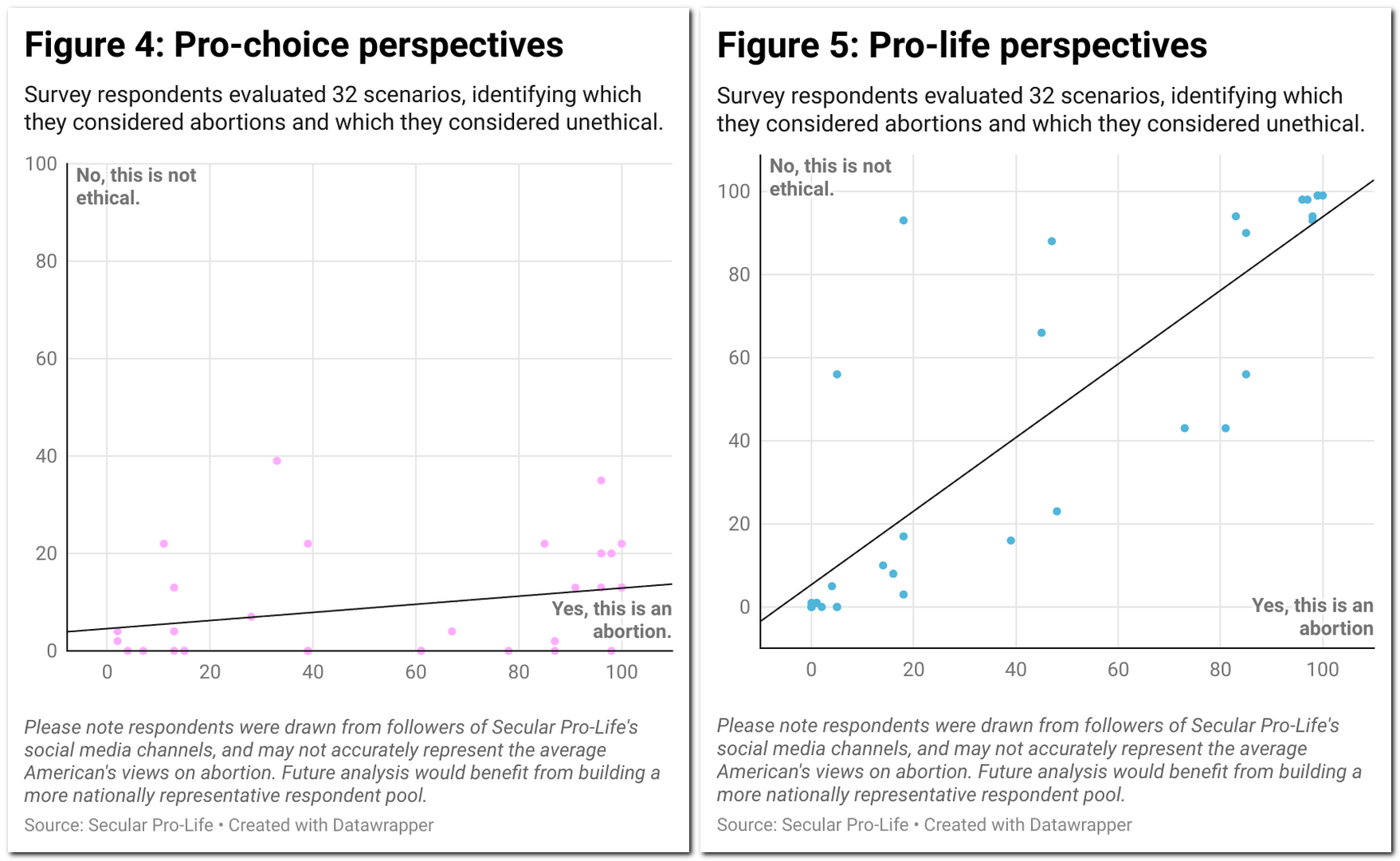
Figures 4 and 5 examine the relationship between whether pro-choice and pro-life people (respectively) consider a scenario unethical and whether they consider it an abortion. Juxtaposing these two figures, we can see the pro-choicers were a lot less likely to consider any scenarios unethical, and there wasn’t much relationship between what they thought of the ethics and whether they categorized the scenario as an abortion. In contrast, pro-life people showed a strong correlation between ethics and categorizing situations as abortions.
Discussion
Which scenarios are abortions?
Few people believe all ways of ending a pregnancy are abortions.
In the introduction I reviewed how pro-choice and pro-life organizations define abortion.
Generally pro-choice organizations give a broad definition about any safe ending of a pregnancy. We see this view reflected in some responses to the survey. For example, one pro-choice respondent categorized every c-section as an abortion, explaining
An abortion is the removal of the products of pregnancy. So technically a c-section is an abortion.
Pro-choice respondent
This response was unusual, though. Few pro-choicers categorized all ways to end pregnancy as abortions. For example, 91% of pro-choicers said a planned C-section at term was not an abortion.
Still, pro-choicers are more likely to categorize scenarios as abortions.
A greater percent of pro-choicers than pro-lifers categorized situations as abortions for over 75% of the scenarios (25 of 32).
This includes situations both sides called abortions, such as “A woman gets a D&E on a healthy fetus when there is a maternal health emergency”; pro-choicers were still 13 points more likely to say “Yes, that’s an abortion” (85% of pro-lifers thought this was an abortion, compared to 98% of pro-choicers). This also includes situations both sides overall said weren’t abortions, such as “A woman gets a D&C to remove retained placenta after she births a live, healthy infant.” Even in this case pro-choicers were still 15 points more likely than pro-lifers to say this is an abortion (0% of pro-lifers thought this was an abortion, compared to 15% pro-choicers).
We saw in the results that whether pro-lifers consider a scenario ethical is strongly related to whether they call it an abortion. Pro-lifers may avoid calling categorizing certain actions as abortions if they think those actions are justified, while pro-choicers don’t appear to face the same tension.
We’ve seen above that for pro-choicers, whether a scenario is ethical isn’t so strongly related to whether it is an abortion. This raises the question of what does determine whether a scenario is an abortion.
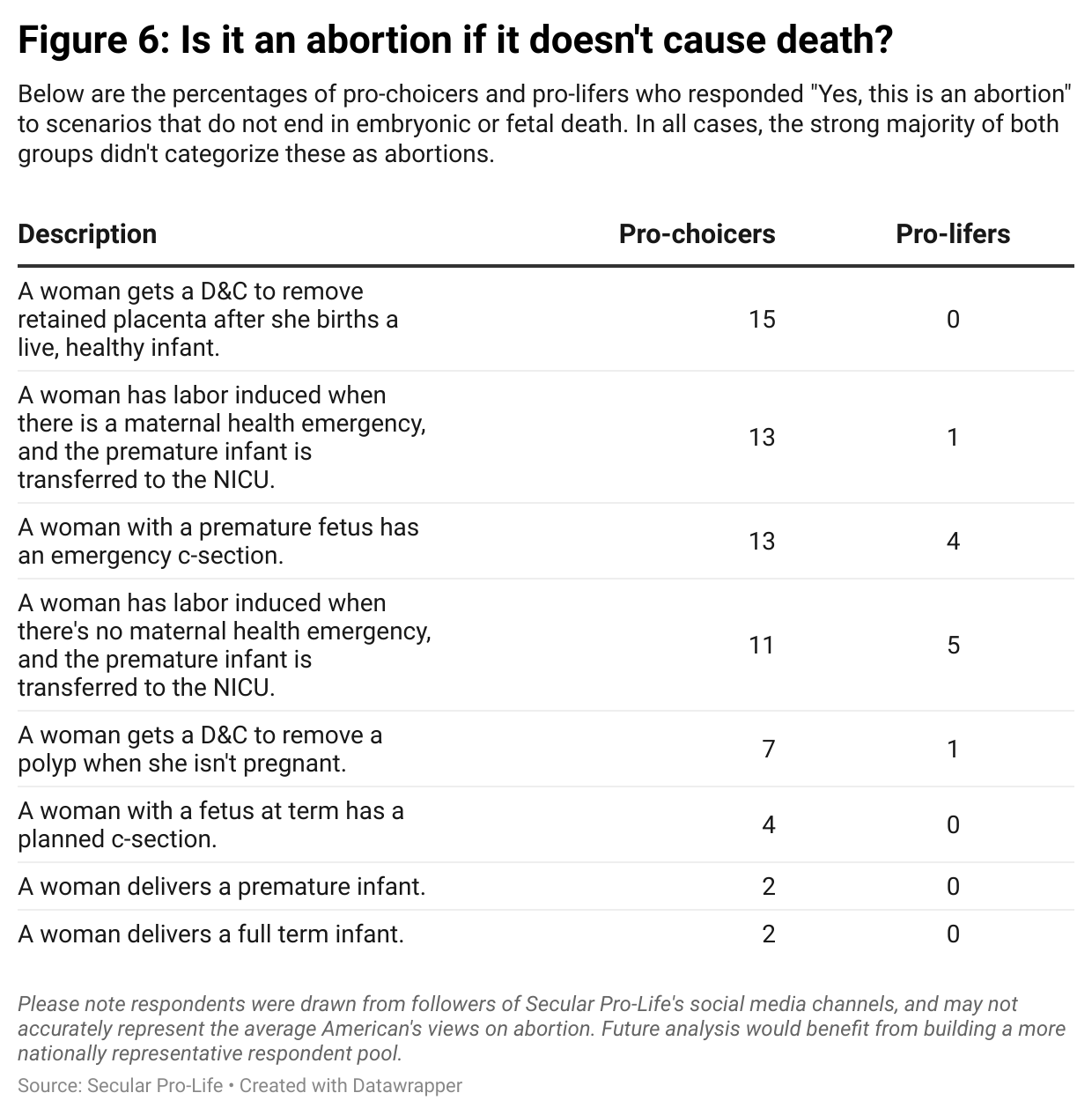
Few people believe a scenario is an abortion if it doesn’t end in death.
Occasionally an abortion advocate will argue that the point of abortion is not to end the life of an embryo or fetus, but only to terminate the pregnancy. It appears most people would consider this a distinction without a difference.
The survey included multiple scenarios where the pregnancy is terminated but no embryo or fetus dies. Pro-choicers were a bit more likely than pro-lifers to call some of these cases abortions, but still fewer than 5% of pro-lifers and 15% of pro-choicers did so. Death isn’t seen as optional or secondary—both pro-lifers and pro-choicers seem to consider it a defining feature of abortion.
Most people don’t consider miscarriage or stillbirth types of abortion.
Within the medical community, miscarriage is often referred to as “spontaneous abortion.” Some abortion advocates will emphasize this fact when arguing a person who has had a miscarriage has had an abortion.
The definitions for this section of the survey included:
- Miscarriage is the natural death of an embryo or fetus before the 20th week of pregnancy.
- Stillbirth is the natural death of a fetus after the 20th week of pregnancy often during labor or just before delivery.
Our survey results suggested most people don’t agree that these are types of abortions.
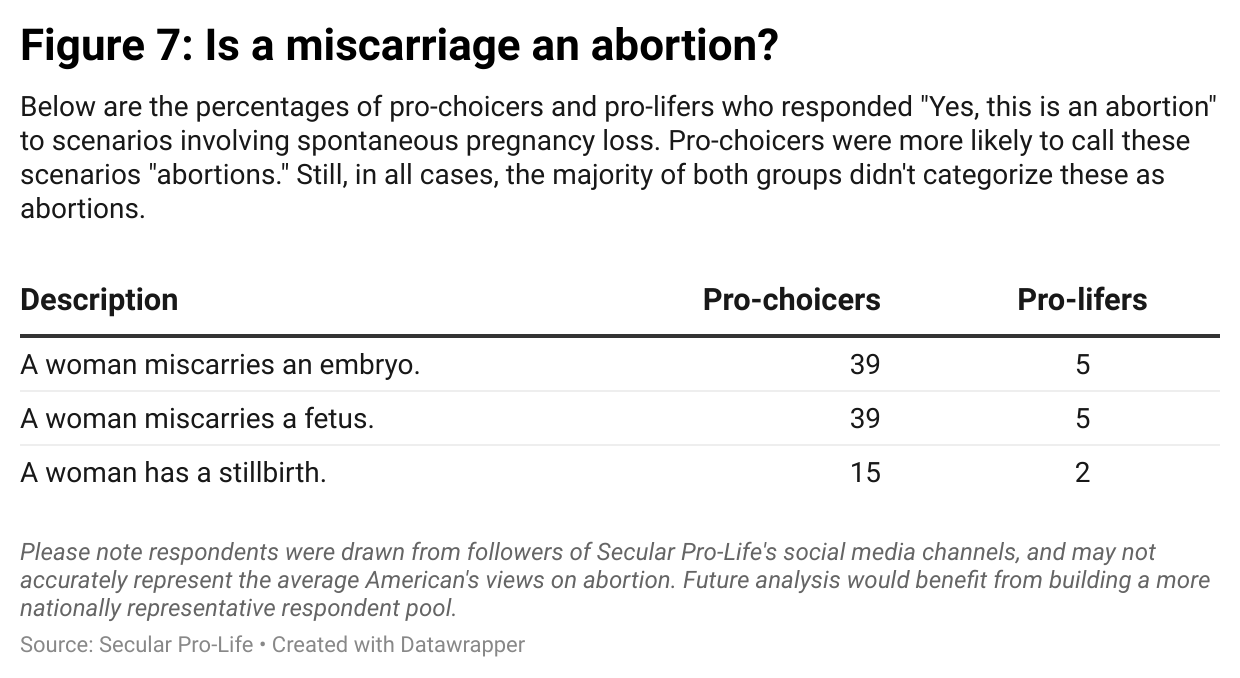
Pro-choicers were much more likely than pro-lifers to categorize miscarriage as abortion (39% vs. 5%). Still most pro-choicers did not categorize it as such. And fewer pro-choicers (only 15%) would describe a stillbirth as an abortion. This means at least 14% of pro-choicers were comfortable calling natural death of the embryo or fetus “abortion” if it happens before 20 weeks gestation, but not after.
Perhaps this distinction is similar to definitions of abortion that specify a gestational limit. (Recall Yale said abortion is “the termination of a pregnancy before the fetus can survive outside the uterus.”)
But then again, Guttmacher has long cited approximately 1% of abortions nationally happen after 21 weeks (likely the stat is slightly higher). Given about 1M abortions per year in the US, that would mean annually at least 10,000 abortions end the lives of fetuses older than 20 weeks gestation. If induced abortion happens beyond 20 weeks, and if natural embryonic/fetal death is “abortion,” it seems like stillbirth would also qualify.
Pro-lifers are divided regarding treatment of ectopic pregnancies.
Meanwhile pro-life organizations give an intent-based definition (an abortion involves the intent to kill an unborn child). We again see this view reflected in the survey: one pro-life respondent categorized removal of the fallopian tube in an ectopic pregnancy as not an abortion, but said treating an ectopic pregnancy with methotrexate may or may not be an abortion. The respondent explained (emphasis added):
Taking the drug, especially after a heartbeat is detected, intentionally kills the embryo, while the surgery removes the tissue around the embryo and the death is an unfortunate result.
Pro-life respondent
Pro-lifers were fairly split on the options for treating ectopic pregnancy. When comparing the options of removing the fallopian tube versus taking methotrexate after detecting embryonic heartbeat:
- 27% of pro-lifers said both were or might be abortions
- 34% said removing the fallopian tube was not an abortion, but methotrexate was or might be
- 39% said neither were abortions
- 0% said removing the fallopian tube was an abortion but methotrexate was not
Of the 34% who considered one an abortion and not the other, quite a few discussed reasons involving intentionality (all emphasis added):
- Intent is the biggest thing here. Yes, removing the fallopian tube causes the embryo’s death, but the intent isn’t to kill the embryo, but to protect the health of the mother in a situation where the embryo won’t survive anyway. Taking methotrexate to deliberately kill the embryo is unethical, and an abortion, because the embryo is being deliberately killed, even though it’s not viable and the procedure is used to protect the health of the mother.
- If the embryo is still living and is the target of a procedure to kill it, that’s abortion. If the embryo dies as a side effect of a procedure targeting a woman’s body part, that’s not abortion. Intent and targets matter just like self defense vs murder.
- I would define abortion as intentionally killing the child before removal.
How do we distinguish intent to kill from other intentions?
I’d expect that the intent of using methotrexate would be to safely treat ectopic pregnancy while avoiding permanent damage to reproductive structures and functions, and avoiding the risks and difficult recovery of surgery. It’s not clear to me how people who are focused on intent determine that the intent of methotrexate is to kill an embryo while the intent of removing the fallopian tube isn’t.
In his book Beyond the Abortion Wars, bioethicist Dr. Charles Camosy, a professor at Creighton University School of Medicine, offers some insight:
When teaching this distinction to my students, I use something they affectionately call the “Camosy pissed test,” which may help determine whether someone is aiming at death. … Would the mother be upset (i.e., “pissed”) if the child lived through the procedure? Of course not. She would be overjoyed.
Beyond the Abortion Wars, Charles Camosy
Camosy was applying this framework to the hypothetical of a pregnant woman with uterine cancer having her uterus removed, arguing such removal wouldn’t be aiming at the death of her child. It seems to me the same reasoning applies to methotrexate for ectopic pregnancies. Perhaps others disagree, but I think this is how intent-based definitions of abortion can get complicated.
Where is there potential for common ground?
There were scenarios that both pro-life and pro-choice respondents generally agreed either were abortions (most interventions resulting in death without medical emergency) or were not (scenarios that didn’t result in death). Whether a scenario qualifies as an “abortion” isn’t always confusing, even when our ethical views of the scenario aren’t aligned.
At the same time, pro-life and pro-choice respondents each had scenarios where their own group gave mixed answers about whether it was an abortion, suggesting that neither group has a universally clear or consistent concept of abortion.
What scenarios are unethical?
Pro-lifers don’t think all abortions are unethical.
There were a few scenarios significantly more pro-lifers said were abortions than said were unethical.
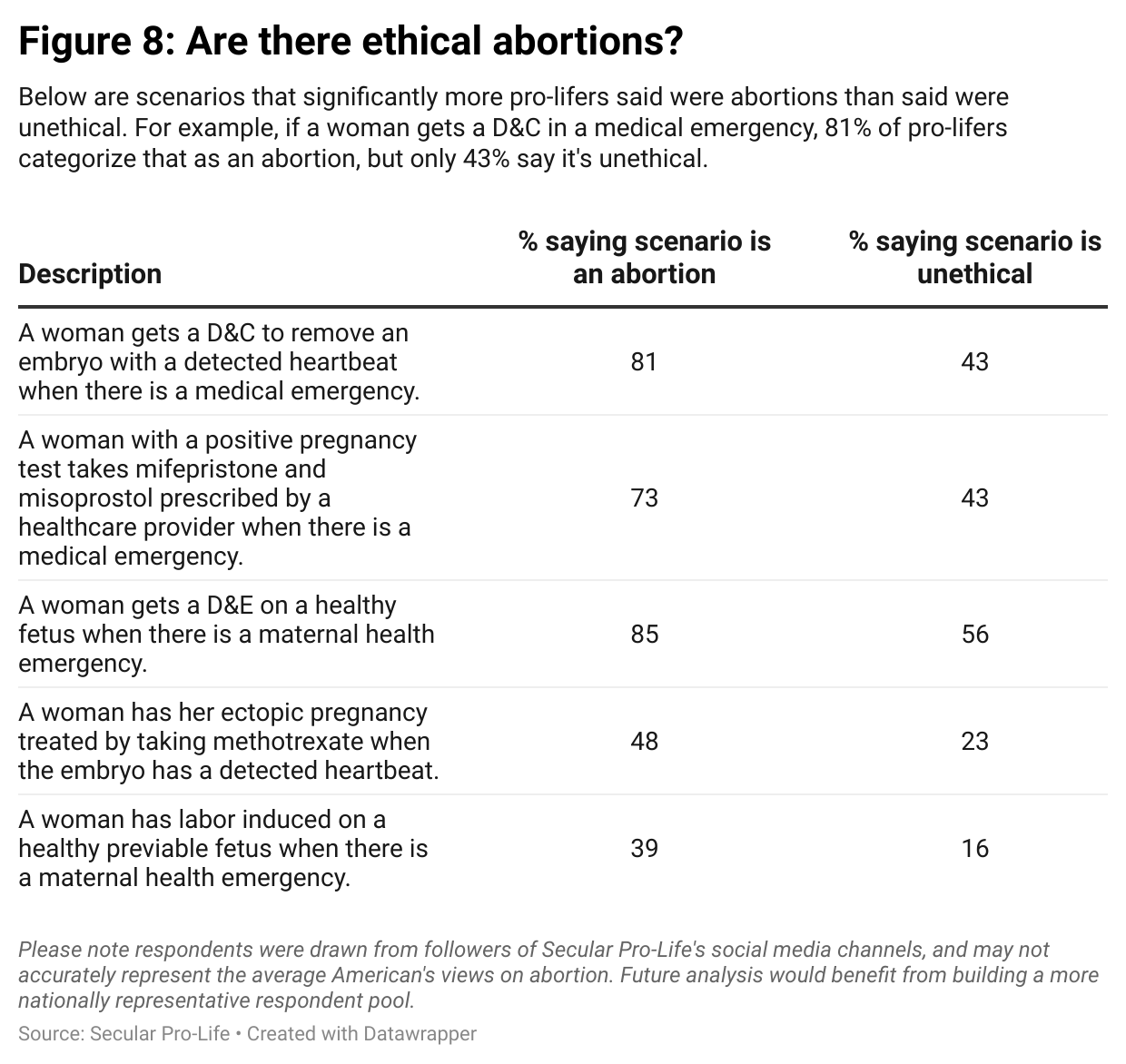
For pro-lifers, “ethical abortions” are those done in medical emergencies.
All of the above scenarios involve medical emergencies. The only scenario that doesn’t explicitly mention an emergency is that of ectopic pregnancy, but in that case the dangerous nature of the scenario is included in the section definition (“Ectopic pregnancy is when an embryo has implanted abnormally, most commonly in the fallopian tube. If the embryo isn’t removed and continues to grow, the fallopian tube can rupture, leading to life-threatening bleeding.”)
The widest gaps between whether pro-lifers considered a scenario an abortion and whether they considered it unethical were for intervention in medical emergencies.
Do pro-lifers think some abortions are medically necessary?
Some pro-life leaders and groups argue abortion is never medically necessary. This is an important claim to understand. When they say this, they are using a specific, though often unspoken, definition of abortion. Their definition includes two key ideas about intention: (1) an intervention only counts as an abortion if the intention is to end the embryo’s life, and (2) some interventions are assumed to have the intention of ending the embryo’s life, even if they are performed during a medical emergency.
For example, these pro-lifers might say that previable labor induction may or may not be an abortion. If a mother has labor induced before viability because there’s a medical emergency, the intention is not to end the embryo’s life, but to save the mother’s. Therefore this situation is not an abortion. But if labor is induced before viability because the woman said she’s not ready to have a child at this time, these pro-lifers would call such a situation an abortion, because the intention is to end the embryo’s life. In both cases, the intervention method is the same, but the intention decides whether the intervention is considered an abortion.
In contrast, in cases where a woman has a D&E procedure (a “dismemberment abortion”), these same pro-lifers would always consider the D&E an abortion. They argue that D&E is never needed in emergencies because other methods, like a c-section, are faster and safer. And if D&E’s are never medically indicated, they would only be performed with the intention of ending the fetus’s life. So in the case of D&E’s, the method itself qualifies the intervention as an abortion, even if it is performed during a medical emergency.
The survey results reflect some of these distinctions. Notice in Figure 8 above each intervention will result in the embryo or fetus’s death, but in the case of previable labor induction, only 39% of pro-lifers categorized it as an abortion. For many pro-lifers, foreseeable embryonic death is not the only factor; the method matters.
It’s not clear to me, though, the major difference in method between previable labor induction and taking abortion pills. In both cases the method “disconnects” the embryo or fetus from the woman in a way that the child will die. Why one is always considered abortion and the other isn’t, I’m not sure.
Pro-choicers don’t think any abortions are unethical.
I exaggerate slightly. There are definitely pro-choicers who will say certain scenarios are unethical. However there were no scenarios that a majority of pro-choicers categorized as unethical.
The closest was the scenario “A woman has fetal demise induced on an otherwise healthy fetus, and then has labor induced.” In that case 96% of pro-choicers said it was an abortion, and 35% said it was unethical. One of the pro-choice respondents who categorized this scenario as ethical explained:
Fetal demise is an issue for delivery. Different delivery techniques can be used on a demised fetus than a living fetus. It can have an impact on maternal health and morbidity risk. Forcing someone to do delivery without fetal demise is not that different from forcing someone to get a C-section.
Pro-choice respondent
Another pro-choice respondent categorized all 32 scenarios as “It’s not ethical or unethical. It’s not an ethical issue.” This person commented explaining
Abortion is a medical intervention that ends a pregnancy. Pregnancy always affects a woman’s life and health. Therefore, it’s not an ethical issue any more than any other medical procedure.
Pro-choice respondent
Worth noting, too, that even when a respondent categorizes a situation as unethical, their answer doesn’t indicate whether they think the fact of an embryo or fetus dying is the unethical element. For example, in response to the scenario about a woman taking mifepristone and misoprostol acquired without a medical provider’s oversight, one pro-choice respondent categorized the situation as unethical because, as they explained: “Putting someone in a position to take abortion pills without a medical checkup or medical supports is unethical.”
Conclusion
Our survey demonstrates how varied people’s understandings of abortion can be. Of course there are plenty of places where pro-choice and pro-life people disagree, especially regarding the ethics of different scenarios. But there are also quite a few areas of overlap. The findings highlight an opportunity: instead of assuming everyone on “the other side” (or even on “our own side”) thinks the same way, we should approach conversations about abortion with more curiosity, and keep looking for areas of common ground as launch points. Hopefully we can move toward more thoughtful conversations and ultimately clearer public language.
If you appreciate our work and would like to help, one of the most effective ways to do so is to become a monthly donor. You can also give a one time donation here or volunteer with us here.