

What Do Christians Have in Common with Unbelievers–If They’re Pro-Life?
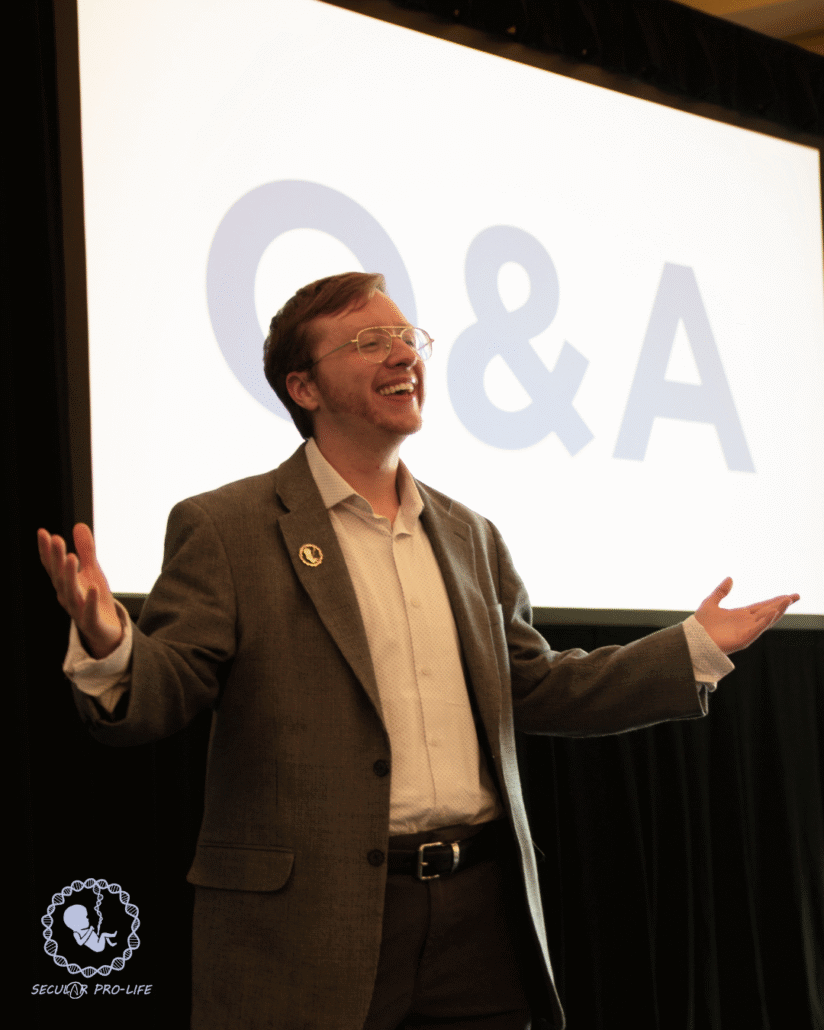
This interview was originally published in Solid for America Magazine. Some changes in formatting were made for the reader’s convenience. See SPL’s page on Religion (or lack thereof) for more information.
Editor: I see that Secular Pro-Life has been around since 2009, but I just recently found out about it. One thing that especially got my attention on the Secular Pro-Life website is where you say, “Among our followers and supporters are Catholics tired of having their arguments against abortion dismissed as merely ‘imposing religion,’ Protestants interested in more diverse pro-life outreach, and members of a variety of religions who feel mismatched with overtly Christian pro-life organizations.”
Me, I’m a Catholic Christian (formerly an unbeliever) who follows the teachings of St. Thomas Aquinas, one of which is basically that much of Catholic moral teaching is not specifically Catholic or Christian; rather, it should be acceptable to all people of good will even on the basis of natural reason alone. Likewise, I’m not seeing anyone in Secular Pro-Life saying, “I don’t believe in God, therefore I’m pro-life”; rather, the arguments are for all human beings who were already alive before they were born, regardless of religion or irreligion. How would you suggest that the entire pro-life movement today could be enlarged, improved, and unified by focusing on what we can all agree on, based on natural reasoning?

Herb Geraghty: I want to clarify that we do have some members of the Secular Pro-Life community who say they are pro-life because they are atheists. One of our board members, Terrisa Bukovinac, often shares her story as an example. She was once a pro-choice Christian, but after deconverting and identifying as an atheist, she became pro-life. She explains that when she was Christian, she had this idea that abortion was sad, but at least those babies would go to heaven, which is a sentiment we hear often from pro-choice people with religious or spiritual backgrounds.
But when Terrisa stopped believing in God, she says she realized that this life is all we have. That shift made ending the life of an unborn child seem like an even greater injustice. If there’s no heaven waiting, then ending a life means taking away everything that person will ever have. And since the unborn are human beings, it follows that it’s wrong to kill them for the same reason.
Editor: Interesting! I’ve heard that atrocious rationalization for abortion before, but not that reason for rejecting the rationalization. In fairness to pro-life Christians who may read this interview, though, I should add that we do have a reason for finding the rationalization just as bogus as you do. The basic idea is that God has a good reason for putting us in this world rather than sending us straight to heaven.
Often, though not always, the reason is to enable us to do good for ourselves and other people even when it might be much easier to do evil–which you can no longer do if you’re in heaven, where there are no incentives to do evil. And mere human beings, who are neither all-wise nor all-good, sure aren’t entitled to substitute their judgment for God’s judgment about whether other human beings should be alive in this world or not.
Herb Geraghty: That said, at Secular Pro-Life, we’re not prescriptive about why people should defend human life. Teresa’s story is just one example, but others in our organization come from more academic philosophical backgrounds. They might approach the issue through frameworks like categorical imperatives or other forms of secular moral philosophy – all of which lead to the same conclusion: it’s wrong to intentionally kill an innocent human being.
In general, we don’t find it necessary to convince people that killing is wrong. Most Americans, whether they’re Christian, Jewish, Muslim, atheist, or anything else, already oppose the unjust killing of non-aggressors. The challenge is showing them that the pro-life position fits within the moral principles they already hold.
Editor: I’m sure that’s right. That, I believe, is why some pro-abortion zealots came up with the nightmare fantasy of the unborn “aggressor brat”–i.e., the idea that an unwanted unborn child, unbeknownst to the child, is a sort of unjust aggressor comparable to an attempted murderer. It doesn’t matter to the zealots that the unborn child totally lacks the culpability to commit any crime!
Herb Geraghty: So, if a Christian is speaking to another Christian, we’d never tell them to avoid religious language. If both people believe in the Imago Dei, of course, that could be a persuasive argument. But we also believe everyone should be able to make a purely secular case for life because not everyone shares that belief. And because even many Christians say things like, “I’m personally pro-life, but I wouldn’t impose my religion on others.” For those conversations, secular arguments are essential. I think they’re often the most persuasive and, for some audiences, the only kind that will resonate.
They also align with our country’s traditional commitment to the separation of church and state. If abortion were wrong only because a particular religion said so, that’s not a strong argument for criminalization. Things like lying or premarital sex can be considered sinful in many faiths but they typically aren’t made illegal in the United States. But abortion is different. It ends the life of a human being. No one argues that banning the killing of born people is “forcing religion” on others, because it’s a matter of protecting human life, not enforcing theology.
The same principle applies before birth. That’s why we insist on a strong secular foundation for our arguments. Not just because it’s persuasive to a broader audience, but because in a pluralistic society, our laws should exist to protect people from harm. And liberal abortion laws fail to protect both unborn children and their mothers.
Editor: Individual pro-life atheists have been around for a long time, some of them pretty well known; I’m thinking of people like Kurt Vonnegut, Nat Hentoff, and (for a while) Bernard Nathanson, after he became pro-life but before he became a Christian. But who first came up with the idea that there could actually be an organization defying the stereotypes of pro-life people as almost all Christians, and unbelievers as almost all anti-life–and what did they proceed to do about it?
Herb Geraghty: Yes, there have absolutely been pro-life atheists throughout history, and many have been active in anti-abortion efforts. But as far as I know, the first organization founded specifically to give a home to non-religious pro-lifers was Secular Pro-Life, started in 2009 by Kelsey Hazzard, who still serves as our president today. In the beginning, Secular Pro-Life was mostly an online community, a space for pro-life atheists and agnostics who wanted to connect with others like them.
At that time, we focused on building community and visibility, inviting secular pro-lifers to join us at the March for Life, putting out online content, and showing up for both pro-life and pro-choice audiences to speak about abortion. We were completely volunteer-run for more than a decade, led by Kelsey along with Monica Snyder and Terrisa Bukovinac, and supported by countless volunteers over the years.
Then, in 2021, Monica decided to take a huge step forward. She became our first full-time staff member, support raising so she could dedicate herself fully to the work. I think that’s what moved us beyond “a really good Facebook page” into the professional, active movement we are growing into today. Every day we meet people who tell us they’re pro-life but feel alienated from the broader movement, maybe because they’re atheist or agnostic, politically progressive, LGBTQ, or just uncomfortable in spaces where certain religious beliefs are assumed. When they find us, they realize they’re not alone, and that they do have a place in the movement.
So while part of our work is engaging pro-choice people and making strong secular arguments against abortion, another huge part is simply creating space for non-traditional pro-lifers to connect and take action together.
Editor: What about you? Your introduction article says you’re a pro-life atheist. Correct me if I’m wrong, but I’m guessing you first became an atheist and later became pro-life. If so, how did that come about, and what did you do about it? If not, what did happen?
Herb Geraghty: I don’t have a dramatic conversion story from being pro-choice to pro-life. From when I first started forming political opinions, I tended to lean liberal on most issues. As a teenager, I identified as a feminist, I opposed the death penalty and war, and I believed strongly in nonviolence. So at first, being pro-choice seemed to fit right in with those values since it was presented as the pro-woman, progressive position, and I accepted that.
But when I learned what actually happens in an abortion, I realized those beliefs didn’t align the way I thought they did. My convictions about equality, non-discrimination, and nonviolence couldn’t be reconciled with the reality of abortion. When abortion was described to me only in euphemisms like “choice” or “healthcare,” of course I supported it, I believe in women’s autonomy and access to medical care. But those terms obscure what’s really happening. Abortion isn’t simply a procedure that makes someone not pregnant; it’s an act that ends the life of a child through extreme violence.
I also believed that our ethics and our laws should be grounded in science. And the scientific community is in consensus: every human’s life begins at conception. Once I understood that, it no longer made sense to say that the right to life should begin at some later, arbitrary stage of development. If every human being has a right to live free from violence, then that right should begin when our lives do.
Editor: Many people, I think, would find it surprising that people who don’t believe in a supremely good and wise Creator of human life can nevertheless hold basically the same belief about the value and dignity of human life as those who do believe in the Creator. Do you agree that many people would probably find it surprising? If so, why? And why do you not find it surprising?
Herb Geraghty: People are often surprised when they meet a pro-life atheist but honestly, they shouldn’t be. According to national polling, there are literally millions of us. Secular Pro-Life has compiled some of that data, and even the most conservative estimates suggest well over 12 million non-religious Americans believe abortion should be illegal in all or most cases. So still a minority, but not at all insignificant.
But more importantly, there’s nothing contradictory about it. About a third of this country either describes themselves as an atheist or says they don’t belong to any religion in particular. Almost none of those people support legalizing murder in most cases. In fact, secular people are often on the front lines of movements for human and civil rights. When I participated in local Black Lives Matter rallies in Pittsburgh after an unjust police killing, no one ever asked me, “If you don’t believe in a supremely good and wise Creator of human life, why do you think it’s bad when an unarmed black teenager is gunned down?” Nobody has ever questioned me at an anti-war protest about why I think human lives overseas have value.
In general, people understand that moral convictions don’t necessarily require belief in a God. For some reason, that goes out the window when the topic is abortion. As a secular person, I find the double standard frustrating. Whether it comes from pro-choice atheists or from pro-life Christians, it’s offensive to suggest that only one religion or metaphysical framework has a monopoly on opposition to literal child killing. People like me can and do oppose violence, discrimination, and injustice across many issues. Abortion is violence, discrimination, and injustice, so it makes perfect sense for everyone to oppose it regardless of whatever else they do or don’t believe. Morality can and does exist outside of religion and the belief that human beings deserve protection from violence doesn’t belong to any one faith or worldview.
Editor: In view of the focus on arguments that all people of good will can accept, without regard to religion or irreligion, I’m thinking pretty much everything in Secular Pro-Life would remain the same even if (improbably) all the leaders and members were to become Christians–except that people would have to insert “former” in front of “atheist” in their descriptions of themselves. Do you think that’s true? Why or why not?
Herb Geraghty: I think you’re probably right, at least when it comes to our shared belief in the right to life. But I would add that many people who align with Secular Pro-Life also fit into the mold of skeptics, and I think that’s one of the qualities that sets our leadership apart. I don’t necessarily think that atheists are the only people with an inclination toward questioning and evidence, but I do think that for many of us, it can be a part of our identity.
Of course, we’re skeptical of supernatural and faith-based claims but that same habit of skepticism can also shape how we approach the abortion debate and how we engage with the world in general. And I think that serves us well. When we hear sweeping claims, whether from the media, politicians, or even within the movement itself, many of us are naturally inclined to dig deeper, and to ask, “Is that actually true?” That skepticism helps us get closer to the truth, which should matter to everyone, regardless of belief.
So whatever changes any of us might experience in our worldviews over time, I would hope that the unique way of looking at the world that is often found in the secular community remains in some form within our movement.
Editor: Actually, so do I. Not only did I used to be a Bertrand Russell-like agnostic once upon a time, but now I follow St. Thomas Aquinas, who always started out his articles with the best arguments he could find against what he was going to say. Faith, he says, goes beyond what we can agree on by reason alone, but it never contradicts or destroys what we can know by reason–and to make sure we know it, we have to dig deep and ask, “Is that actually true? What about these great reasons for thinking it’s false?”
Thanks for a great interview, Herb! I presume you’ll have no objection to my ending up the interview with this comment: “You may not believe prayer has any effect, but I do–and I’ll pray for the continued success of Secular Pro-Life as an important part of the pro-life movement.”
Herb Geraghty: No objection! Thanks 🙂
If you appreciate our work and would like to help, one of the most effective ways to do so is to become a monthly donor. You can also give a one time donation here or volunteer with us here.