
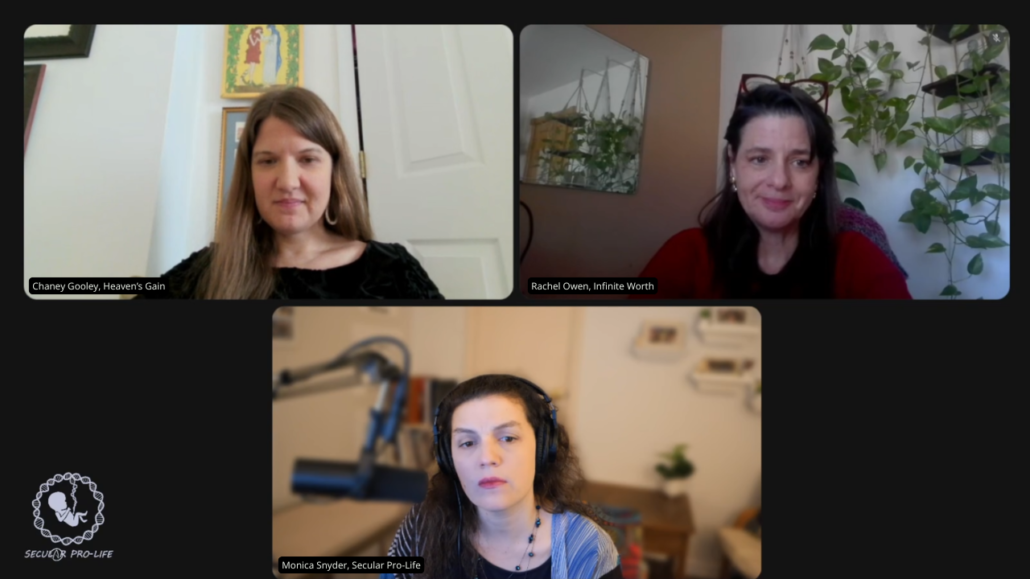

Why pregnancy centers should offer miscarriage kits: an interview with Chaney Gooley and Rachel Owen
I spoke with Chaney Gooley, a nonprofit consultant for Heaven’s Gain, and Rachel Owen, the CEO of Infinite Worth, about miscarriage kits, which are tools for helping loss parents identify and preserve embryonic or fetal remains in the course of at-home miscarriages.
The three of us talked about the major gaps in society’s approach to miscarriage and how these kits can help us build more supportive communities. We especially considered how pregnancy resource centers might fill an important role in helping people through pregnancy loss.
Watch the full interview here, and see key takeaways, a summary, interview “chapter” list, and additional resources below.
Key Takeaways
- Our society has huge gaps in caring for parents experiencing miscarriage, including both in medical settings and at home.
- Miscarriage kits provide practical support tools for the intense physical and emotional experience of a woman’s body expelling an embryo or early fetus.
- These kits, and the education meant to accompany them, provide real opportunity for improving hospital protocols, expanding pregnancy center services, and building more compassionate communities.
Summary
“We have somehow managed to develop a society that basically just doesn’t address miscarriage.”
Roughly 1 in 4 detected pregnancies end in miscarriage, yet hospitals, OBGYN offices, pregnancy resource centers, and similar institutions often don’t prepare women for the physical or emotional impacts. This lack of preparation can add unnecessary trauma to an already fraught experience.
In this conversation, Chaney described the contents of a miscarriage kit, emphasizing that these kits are a delivery aid (not to be confused with a comfort or sympathy gift). The kit includes tools for measuring blood loss, safely collecting remains, and giving options for burial or cremation. The purpose of these kits is not to tell anyone how to feel about pregnancy loss, but to give parents control and dignity as they navigate their losses.
“Life is valuable, and we need to honor it at every stage.”
Before working with Infinite Worth, Rachel had been the executive director of multiple pregnancy resource centers. In this interview, she described repeatedly witnessing clients experiencing and grieving miscarriage, yet the centers often had little support to offer. Rachel has also seen abortion-determined women receive an ultrasound, learn there’s already no heartbeat, and break down in tears. Every center director she’s spoken with has witnessed that situation.
Miscarriage represents real loss, even in difficult circumstances, and centers that offer the miscarriage kits report stronger staff morale and increased client wellbeing. Both Rachel and Chaney also noted positive responses from donors, who appreciate that the organizations they support are addressing miscarriage openly and respectfully.
“Pregnancy loss happens to everybody.”
I underscored that miscarriage kits and better education about what to expect during miscarriage are efforts anyone can support, regardless of their stance on abortion. People can have a wide variety of views on the moral status of embryos, still care a lot about women’s wellbeing, and want to support people enduring loss. Better miscarriage care serves everyone.
We also talked about people who have already presented the miscarriage kits to their local hospital boards and started advocating for more hospitals to have this resource available. Medical staff report higher job satisfaction when they have the training and resources to address their patients’ needs, and hospitals are more open to changes when presented with ready-made protocols. If communities push for change, hospitals can improve quickly.
Interview Chapters
The interview is about an hour long, but if you want to skip to specific sections, here are the time stamps:
- 7:36 The hospital gap in miscarriage care
- 9:25 What is the miscarriage kit?
- 12:17 Addressing the concern that miscarriage kits are traumatic
- 19:45 Addressing the mission creep concern
- 20:49 Which women do PRCs serve?
- 22:17 Explaining why miscarriage kits are important for PRCs
- 27:22 Our experiences with grief teach us how to support others who are grieving
- 29:49 Miscarriage kits can be common ground between pro-life and pro-choice people
- 31:15 Abortion-minded women also experience miscarriage
- 33:31 Contrasting how pro-lifers talk about abortion vs miscarriage
- 35:34 PRCs have been using miscarriage kits successfully
- 39:54 Why PRCs should offer more options for miscarriage than referrals to emergency rooms
- 43:45 Addressing the concern about limited time for patient appointments
- 46:02 How PRC donors respond when centers offer miscarriage kits
Additional Resources
- Heaven’s Gain miscarriage kits
- Secular Pro-Life’s suggested hospital protocol: Fetal Remains Disposition and Patient Support Policy (and a flyer promoting the protocol to hospital staff)
- Essay: Helping Loss Parents Heal After Miscarriage: The Critical Role of Medical Professionals
- Livestream recap: Personal Stories and Policy Gaps Around Miscarriage
If you appreciate our work and would like to help, one of the most effective ways to do so is to become a monthly donor. You can also give a one time donation here or volunteer with us here.
