
Abortion Shield Laws and the Fate of Federalism
Today’s guest post is written by Lindsay Gabow, a second-year student at Harvard Law School.
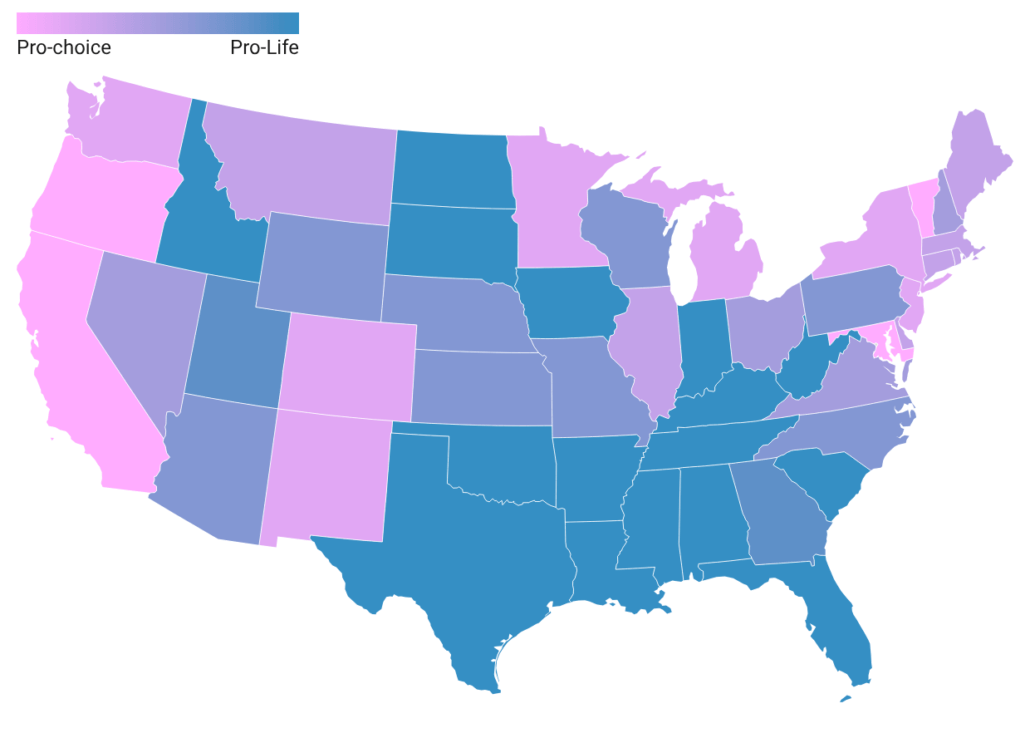
In 2022, the Supreme Court held that the Constitution does not protect the right to abortion. The decision, Dobbs v. Jackson Women’s Health Organization, reversed almost fifty years of precedent. While Dobbs resulted in various red states adopting abortion bans, a curious statistic has emerged since the decision. The number of abortions nationwide has increased. And many of these abortions are happening in states that virtually ban or severely restrict abortion.
[Read more – Did Dobbs make any difference? Guttmacher reports over 1M abortions in 2023]
This discussion draws a contrast between abortion laws and medical aid-in-dying (MAiD) laws. As with abortion, the Supreme Court held that the Constitution does not protect the right to physician-assisted suicide. However, the response of liberal states to the Court’s decision on physician-assisted suicide looks quite different to their response to Dobbs. The states that permit MAiD take measures to contain the practice within their own borders. In turn, these states respect other states’ self-governance. By contrast, various states that permit abortion do the opposite, enacting shield laws that facilitate abortions in states that ban or limit the practice. States with abortion shield laws impede other states’ self-governance.
How is it possible that the national abortion rate has increased after Dobbs? The primary answer is the rise of telehealth abortions facilitated by mifepristone, an abortion-inducing drug. Most women accessing mifepristone by mail are those living in pro-life states. This is striking, because these states often ban telehealth abortions. Rather than respect these abortion bans, various pro-choice states have enacted shield laws that protect abortion providers mailing mifepristone and misoprostol to women in anti-abortion states. In doing so, pro-abortion states are effectively preserving abortion access in anti-abortion states — violating the spirit of Dobbs and the principle of federalism more broadly.
[Read more – Why is prescribing abortion pills an exception to established medical practice? Welcome to shield laws.]
As their pro-choice label suggests, states with these shield laws believe abortion bans subjugate women and wrongfully punish abortion providers. So, for a state like California, it is justified — even necessary — to infringe upon Florida’s sovereign decision to restrict telehealth abortions in its own land. After all, a different type of sovereignty, women’s, is at stake.
Of course, pro-life states construe abortion bans quite differently. These laws are not about oppressing women, but protecting unborn children. To Alabama and Texas, an unborn baby is as much a human life as a newborn. Opposition to abortion flows naturally from opposition to infanticide.
Individuals and states may disagree on when human life begins. Indeed, the Supreme Court recognized this in Dobbs and in turn, devolved the power to define the start of human life to the states. For the purposes of this discussion, we need not resolve the question of when life begins. Instead, we need only acknowledge that states have the prerogative to ban abortion, which is based on an understanding that life begins as early as fertilization, and that all human beings are equally entitled to the right to life. This prerogative falls squarely within the holding of Dobbs. As such, because most abortions happen via medication, it logically follows that states have the power to limit access to mifepristone and misoprostol within their borders. These drugs end the life of (what some states have determined is) a real human person. But thanks to other states’ shield laws, they cannot fully exercise this power in practice.
The same is not true when it comes to medical aid-in-dying. Thanks to Dobbs, the states, not the federal government, determine when life begins, and enact abortion laws accordingly. In Washington v. Glucksberg, the Court held that the Constitution does not protect the right to assisted suicide, ultimately giving rise to states authorizing or prohibiting MAiD. Similarly, Dobbs has resulted in states protecting or restricting abortion. Both Glucksberg and Dobbs exemplify federalism by allowing states to self-govern. In the aftermath of these cases, however, their stories diverge. Glucksberg is a story of states insulating other states from a controversial practice they reject (MAiD). Dobbs, on the other hand, is a story of some states imposing on other states a controversial practice they reject (abortion).
Glucksberg is a story of states insulating other states from a controversial practice they reject (MAiD). Dobbs, on the other hand, is a story of some states imposing on other states a controversial practice they reject (abortion).
Like abortion, MAiD involves ingesting drugs to end life. And like abortion, the states are split on MAiD: Only 12 states and D.C. allow it. But liberal MAiD laws starkly contrast with liberal abortion laws. Whereas pro-choice states have enacted shield laws protecting doctors mailing mifepristone to women in pro-life states, pro-MAiD states impose strict conditions on medical-assisted death. All but two pro-MAiD states require residency. That is, a prospective patient cannot avail herself of medical-assisted death unless she is a resident of the pro-MAiD state.
The two states that do not require residency, Oregon and Vermont, attach physical restrictions to their MAiD statutes. In these states, a prospective patient must travel to Oregon or Vermont for the MAiD process: Every step from undergoing an initial medical assessment to administering the life-ending drug must occur in the state.
The dichotomy between MAiD and abortion is clear. In the former, states respect the police power of other states to prohibit this controversial practice. In the latter, states are taking active measures to undermine other states’ bans. For one procedure that brings about the end of life, liberal states require either residency or that the procedure occurs within their state. But for another procedure that also brings about the end of life, some of the same liberal states do the opposite: They facilitate the procedure in conservative states.
With MAiD, federalism is working; with abortion, it isn’t — thanks to shield laws.